About Me

I am Associate Professor and Chair of the History Department at the University of Massachusetts-Dartmouth. I am also the Academic Director of the Clemente Course in the Humanities, in New Bedford MA. Author of "Social Security and the Middle Class Squeeze" (Praeger, 2005) and the forthcoming "Saul Alinsky the Dilemma of Race in the Post-War City" (University of Chicago Press), my teaching and scholarship focuses on American urban history, social policy, and politics. I am presently writing a book on home ownership in modern America, entitled "Castles Made of Sand? Home Ownership and the American Dream." I live in Providence RI, where I have served on the School Board since March 2015. All opinions posted here are my own.
Showing posts with label inequality. Show all posts

Thursday, January 10, 2013

The real American exceptionalism: our lives are stressful, unhealthy, and short

Back in October 2012, New York Times writer Scott Shane described the idea of 'American exceptionalism' as an "opiate,“ inducing a kind of hubristic national stupor that prevents us from seeing things as they truly are.

The idea that God or history has uniquely blessed the United States, justifying a proselytizing posture toward the rest of the world, is an old one.  It returned to our national discourse in the last couple of years, when conservatives accused President Obama of backsliding in his belief that Americans are the 'chosen people.'

As Shane argued, the idea that American identity is a kind of calling can have positive consequences:  “this national characteristic...may inspire some people and politicians to perform heroically, rising to the level of our self-image."  But it can also be deeply dysfunctional, as politicians of all stripes trip over one another to reassure Americans "that their country, their achievements and their values are extraordinary," while profound problems are left unaddressed.

American patriotism has always -- and uniquely -- had this 'Stuart Smalley' taint to it, but as we collectively whistle through the graveyard of apparent national decline, it seems to have over-ripened a bit.  If John Winthrop's idea of America as the 'city on a hill' drawing the "eyes of all people" was to be more than just an expression of jingoism, it demanded (and demands) a delicate balance between description and aspiration.  When it morphs into mere self-affirmation, however, we Americans become a danger to ourselves -- and to others, who increasingly keep their eyes on us for fear of what might happen if they don't.

Sadly, as a recent international health study bracingly reminds us, most of the ways in which the United States is exceptional today are negative.

The Institute of Medicine just released a study comparing American health care outcomes to other industrialized countries.  And all rhetoric about the U.S. having the 'best health care system in the world' aside, the realities are shocking.  Despite spending far more per capita on health care than any other nation, the data make it abundantly clear that the American way of life has become nasty, increasingly brutish, and comparatively short.

The optimistic takeaway here is that almost everything described below is attributable to (and capable of being ameliorated by) public policy -- in health, but in much broader areas as well.  In other words, if we can once again rediscover our aspirational identity as Americans, change is possible.

Physician Steven Woolf, a professor at Virginia Commonwealth University, chaired the panel that wrote the report.  He and his co-authors were "stunned by the findings."  Americans "have a long-standing pattern of poorer health that is strikingly consistent and pervasive" over a person's lifetime, the study found.

The U.S. is at or near the bottom in virtually every health outcome:  life expectancy, obesity, diabetes, heart disease, and homicide.  We have much higher rates of death before the age of 50, accounting for most of the gap between the United States and our peer nations.

According to the report, most of these poor health outcomes are attributable to poor childhood health.

The USA has had the highest infant mortality rate of any developed country for several decades, due partly to a high rate of premature birth and low birth weight.  Dr. Woolf and his colleagues also note that the U.S. has by far the highest rate of child poverty, though they don't really touch on its role as a possible cause. 

Here is a graphic representation of the infant mortality gap:

This gap, interestingly, has a history.  

The gap between the United States and its peer nations was relatively wide in 1950s and early 1960s, and then rapidly closed.  Why did it close, and so quickly?  Policy -- the 'War on Poverty,' including Medicare/Medicaid, among other programs, which for the first time began to connect millions of Americans to the health care system (and to food) on a relatively consistent basis. 

And then, right around 1980, the gap re-emerged.  This coincided, not surprisingly, with Reagan-era cuts in public health and social programs; but it also coincided with an ongoing increase in economic inequality and insecurity.  Since 2000, the gap between the U.S. and its peers has expanded.  While infant mortality rates among African-American and Hispanics are high, this doesn't explain the gap -- white Americans have higher comparable rates as well.

In short, while we have continued to make progress over the past two decades, our peers have had much greater success:  “although U.S. infant mortality declined by 20 percent between 1990 and 2010,” the report notes, “other high-income countries experienced much steeper declines and halved their infant mortality rates over those two decades.”

The report doesn't really offer any explanations for the infant mortality gap, or for the poor health performance of the U.S. more generally, beyond behavioral factors like drug abuse, calorie consumption, not wearing seat belts, and the ubiquity of handgun violence.

I'm not a health expert, but I do think we need to consider one factor:  inequality.


While economic inequality within nations wasn't the focus of the Institute of Health report, we know from research by epidemiologists Richard Wilkinson and Kate Pickett that it strongly correlates with (and is reproduced by) health outcomes -- such as infant mortality (see above).

This is true in two senses.

First, nations with higher rates of economic inequality tend to have poorer health outcomes across the class structure -- in other words, while health outcomes are better the richer or more educated one is, they will still be lower than those of comparably placed people in more equal countries.  The Institute of Health report confirms this.

Second, economic (and educational) inequality and health outcomes are strongly correlated within societies.  In the U.S., life expectancy for white women without a high school diploma is 73.5 years, compared with 83.9 years for white women with a college degree or more.  For white men, the gap is even larger: 67.5 years for the least educated white men compared with 80.4 for those with a college degree or better.

Because the United States is drastically more unequal than any other comparable nation, the socio-economic gradient is much sharper here -- and its getting worse.  Indeed, we now have evidence that the life span of the least educated white Americans has actually contracted, falling a full four years since 1990.  The numbers are worse for women.  Some of this is attributable to changes in the labor market:  the share of working-age adults with less than a high school diploma who did not have health insurance rose to 43 percent in 2006, up from 35 percent in 1993.  While full implementation of the Affordable Care Act in the coming years may help somewhat, the deeper problems of rising inequality and economic insecurity -- and the debilitating stress and anxiety that accompany them -- remain.

Poor health outcomes, as well as inequality, are greatly exacerbated in the U.S. by our social geography, and its intersection with the nation's original sin of race.  American metropolitan areas have become increasingly segregated by income over the past two decades.  We don't yet have a full picture of the health consequences of this trend, though it certainly is both a cause and a consequence of growing inequality during the same period.

But we do know the health consequences of America's stubbornly persistent pattern of racial segregation.  African-Americans not only have poorer health outcomes than whites overall; this is true even when income and education are held constant.  More than 100 studies over the past decade confirm that racism acts as a classic chronic stressor, with serious physiological consequences: higher blood pressure, elevated heart rate, increases in the stress hormone cortisol, suppressed immunity.  Chronic stress is also known to encourage unhealthy behaviors, such as smoking and eating too much, that themselves raise the risk of disease.  Most of these investigations have been done in the United States, but a growing body of literature originates elsewhere.  "Across multiple societies, you're finding similar kinds of relationships," David Williams, a sociologist at the Harvard School of Public Health, told the Boston Globe.  "There is a phenomenon here that is quite robust."

Racism also appears to have an impact on fetal and infant health, setting off a likely cascade of negative consequences.

Epidemiologists James W. Collins, Jr. and Richard J. David have uncovered a disturbing fact:  American-born black women are significantly more likely to have low birth weight babies than white women are, regardless of income level or education.  The cause, they argue, is steady and life-long exposure to racism and its consequences.  Since low birth weight correlates strongly with poor health (and educational) outcomes later in life, the relationship between race, place and health is clearly a big factor in the reproduction of racial inequality in the U.S.

This relationship has been confirmed more recently in a widely publicized study in the January 2013 issue of the Journal of the American Medical Association, on racial segregation and lung cancer.  After controlling for income and smoking rates, Dr. Awori Hayanga and his colleagues found that lung cancer mortality rates (a ratio of deaths to a population) were about 20 percent higher for blacks who lived in the most segregated American counties, than for blacks living in the least segregated counties.  The more segregated the community, the higher the mortality rate for blacks -- and, disturbingly, the lower the rates were for whites.  They surmised that differential access to health insurance and relevant and timely treatment were largely at fault.  The research of Collins and David also directs us towards the stressors of racism itself, which are in part rooted in America's unequal racial geography.

“If you want to learn about someone’s health, follow him home,” Dr. Hayanga, a heart and lung surgeon at the University of Pittsburgh Medical Center, told the New York Times.   This message -- about the relationship between place, health, and inequality -- was perhaps most powerfully conveyed for an American popular audience by the award-winning documentary Unnatural Causes.

In other words, our unequal and insecure American way of life is making us sick -- and more unequal.

While the mechanisms that connect inequality with poor health outcomes are many and hard to disentangle, it seems clear that stress and insecurity are critical.  Both affect the cardiovascular and immune systems, and both are found in abundance and in greater numbers in unequal societies -- and their effects are devastating on the young in particular.

Thomas McInerny, president of the American Academy of Pediatrics, reacted to the Institute of Health study by pointing to recent research on the long-term impact of "toxic stress" on the health and cognitive development of babies and toddlers.   "It's becoming increasingly clear that the first 1,000 days of life are critically important for children's development, and can determine the course of their life span from then on," McInerny says. "Investing in children in the first three years of life provides higher returns, for improving their productivity as adults, compared to intervening later."

Back in 2007, UNICEF put together an index of child well-being.  It measured material and educational factors, health and safety, peer and family relationships, surveys of subjective well-being, and behavioral risks.  When Wilkinson and Pickett lined this index up with rates of income inequality, they found something striking:  the more unequal a society is, the worse its rates of child well-being -- not just among poor children, but overall:


These correlations and comparisons make one thing clear:  America's poor health outcomes, particularly for our children, can be ameliorated.  Why?  Because the differences between the U.S. and its peers, ultimately, are policy differences -- and thus are amenable to collective action.  We can make America healthier (and more productive) by making it less unequal, and by investing in pre-natal care, early childhood health, and high quality and universal pre-school.  "We already know what to do," Dr. Woolf says. "It's more a matter of having the resolve and resources to actually do it."

Notwithstanding the false scarcity of our current austerity politics, we have the resources.

Notwithstanding the libertarian and narcissistic braying of the privileged, our well-being is ultimately inseparable from that of our fellow Americans.

Whether we have the resolve to see this will ultimately determine whether the term 'American exceptionalism' serves to damn or praise our national experiment.

Tuesday, June 12, 2012

Race, generational politics, and the Democrats great opportunity


The whitening of the Republican Party, and the great white Boomer estate sale

In the June 7th 2012 online edition of the New York Times, columnist Charles Blow broke down the findings of the recent Pew Research Center American Values survey along racial lines.

Blow points to 3 important findings:
First, since 2000, while the percentage of GOP supporters that are white has remained steady (87%), the percentage of Democrats who are white has fallen from 64% to 55%.  Interestingly, the racial breakdown of 'independents' has also changed -- from 79% white in 2000, to 67% white in 2012.  
Blow's conclusion:  "if current trends persist, in a few years the Democratic Party will be a majority minority party."   
Second, whites, blacks and Latinos often have very different views about poverty, opportunity and the role of government.  
Blow's conclusion:  because the Democrats are increasingly diverse racially (blacks, Latinos), while the Republicans are not, these racially divergent views are going to profoundly affect the national debate in this election year.
Third, swing voters (those who are undecided, who lean towards a candidate, or who say that they could change their mind) are overwhelmingly and disproportionately white (nearly 3/4).  Pew found that these voters lean more towards Obama on issues like civil liberties and the role of labor unions, but are closer to Romney on the social safety net, immigration, and affirmative action.  
Blow's conclusion here is implied rather than stated, but the implication is pretty clear:  Obama will lose if the focus of the 2012 campaign is on these 'racially charged issues.'  The deeper implication is that the GOP would benefit from a campaign that is focused on these things.

I don't have any major quibbles with Blow's analysis, though some of the data he cites really pushes one towards a more radical conclusion, one which he didn't hint at, even obliquely:  
As the Democratic Party slowly begins to reflect the demographic changes underway in the country (in its constituencies, if not yet in its positions), the Republican Party is increasingly becoming the Defense of White Privilege Party, and its short-term electoral interests are leading it even further in that direction.   
Of course, behind the curtain an awful lot of what Republican policymakers actually do has much more to do with the protection of capital (particularly financial capital) than the protection of white privilege per se -- but the nudges, winks and dog whistles, particularly for the Tea Party folks, are often racially inflected.  

And if the GOP's defense of the current structure of American wealth (and its defunding of those institutions which might offer wider access to it or challenge it) isn't at the same time a defense of a certain kind of white privilege, what is it?  If those who have climbed the ladder are overwhelmingly white, and you pull the ladder up behind you, what (who) have you defended?  There is no reason to think that because the Party houses within it a supposedly cosmopolitan financial elite and an aging coalition of economically and racially insecure whites, that these differences will somehow temper the racial nature of its appeal.  For most of the history of our country, corporate and financial interests have been entirely comfortable and compatible with a white supremacist politics.

Almost every major policy position the Republican Party now takes will work to the benefit of white voters, and to the detriment of citizens of color.  Attacks on public employee unions and Paul Ryan's call for massive cuts in non-defense spending has (and will) disproportionately affect black and Hispanic workers.  Likewise with pay freezes for public workers, and pension and health insurance cutbacks.  All of this constitutes an assault on a black middle class that has already seen billions of dollars of its wealth stripped away by sub-prime lending and the collapse of the housing market -- with these things, in turn, enabled by financial deregulation and the refusal to meaningfully address housing discrimination and residential segregation.  

Democrats may try to take some comfort in the belief the GOP's coalition of cosmopolitan financial capital and economically and racially insecure whites will inevitably blow apart, as the latter gradually begins to see what is truly 'the matter with Kansas.'  This comfort, however, is misplaced -- at least in the short-term.  What holds this coalition together at the moment is a unifying hostility to the nature and reach of the modern American state.  Financial elites largely maintain the same position on this issue that they have since they wormed their way into the Republican Party in the 1860s and 1870s:  government should be small and weak, except when it aids in the accumulation of capital, and protects it against internal and external competition.  Insecure whites, particularly those who increasingly affiliate themselves with the Tea Party, believe that the young, the lazy and the dark are parasitically living off of the hard work of whites -- aided by President Obama.  

Of course, the GOP hostility to government (and labor) as a counterweight to concentrated economic power and the inherent vicissitudes of life in a market society directly challenges the civil and social rights that have enabled whatever progress toward racial justice we've achieved in the past half-century.  A government with such a diminished reach inevitably comforts the comfortable, and afflicts the afflicted.  That it will afflict a large number of white Americans too -- particularly the young -- is clear.  The future of the country will depend upon whether these white Americans will answer the GOP's racial siren song, or make common cause with their fellow citizens who represent the nation's demographic future.  

While at first blush all of this seems to be about fiscal conservatism, it really isn't.  You can't balance budgets or grow the economy (or govern effectively and justly) with massive tax cuts, and greatly diminished public investments in infrastructure, institutions, and people.  Not only is the GOP no longer the party of Teddy Roosevelt; it isn't even the party of its Whiggish predecessor Henry Clay.  

But more revealing is the nature of the rhetoric on the Right:  we have witnessed the revival of the racially-tinged language of "government dependency," courtesy of the Tea Party.   

Blow notes that a remarkable 90% (!) of Romney's supporters are white (87% of Republicans are), and that white independents also move into the Romney camp when the focus is on social programs and immigration, which he describes as 'racially charged issues.'  

There is no inherent reason why the discussion of social programs during the worst economic downturn since the Great Depression should be 'racial' in nature, particularly since the vast majority of poor Americans are white, and whites are by far the greatest beneficiaries of the welfare state.  Immigration isn't inherently a 'racially charged' issue either; it is a demographic issue, perhaps, but the push and pull factors that shape the flow of immigration are largely economic.

The deeper question is this:  what makes the social safety net and immigration 'racially charged' issues?  Perhaps this is obvious, but it needs to be stated:  it is white Americans who make these subjects 'racial.'  Not blacks, not Latinos, not liberals, and not Democrats.  Whites.

It is well known that by the middle of this century, 'whites' (as Americans have come to define them since World War II) will no longer constitute a majority of the population of the United States.  In many places, this has either already happened, or soon will.  On the eve of the financial crash, the U.S. Census Bureau announced that non-Hispanic whites would become a minority in the country in 2042, eight years earlier than had previously been estimated.

The collision of the Great Recession with demographic change has lent our already-polarized national politics a discomforting flavor of racial apocalypse, diverting many Americans -- and most of the Republican Party -- away from the inequalities that truly matter, and toward a paranoid defense of the favored racial quarter.  We can see this in our daily lives, as American metropolitan areas re-segregate by race, while economic segregation metastasizes across the national landscape.  We can see it in the racialized rhetoric of the Tea Party.  And we can see it in the 'pull-up-the-ladder-of-opportunity' policies that the GOP increasingly recommends.  

White Americans, of course, aren't monolithic.  The Pew Survey makes clear that while a lot of whites seem to be hunkering down in the Republicans' racial redoubt (particularly older whites), those who continue to define themselves as Democrats increasingly share the views of most blacks and Latinos not only on economics, opportunity and the role of government, but also on the issues of immigration, affirmative action and social programs.  The Survey indicates that this is particularly true for younger white voters.  

The percentage of Republicans calling for "tighter immigration controls" has ticked slightly upward over the past twenty year, from 78% to 84%.  There has, however, been a decided downward shift in opinions among Democrats, reflecting both demographic reality and a growing recognition of that reality by their white constituents, regardless of ideology or education.  In 1992 there was basically no partisan gap on the issue; today, only 58% of Democrats think we need a more restrictive immigration policy, down from 74% in 1992.  While independent voters are more favorably disposed toward tighter controls than Democrats are, the trend is largely downward -- reinforcing my point above, about the increasingly racialized GOP.

From the Survey:
In 1992, Republican and Democratic perceptions of the 'threat' immigrants posed to American values differed little; voters in each party were evenly split.  Today, there is a substantial gap:  60% of Republicans believe that immigrants pose such a threat, while just 39% of Democrats do.  Indeed, regardless of ideology or education, Democrats do not perceive immigrants as a threat, though the numbers do vary; the exact opposite is the case among Republicans.  

There also seems to be an age correlation.  While those between 18-29 and 30-49 are (for lack of a better term) 'pro' immigrant, older voters are not.

According to the Survey, Tea Party Republicans and Tea Party-leaning independents both seem to be more likely to be hostile to immigrants and skeptical of the persistence of racial discrimination than do Republicans more generally.  

In other words, the Tea Party is a force for the continuing racialization of the GOP, as much as its most prominent advocates wish to deny it.

The GOP has effectively become the anti-immigrant party, as Thomas Edsall noted recently.  Its constituents will not support candidates perceived as 'pro-immigrant,' as John McCain discovered in 2010.  And within the larger context of economic insecurity -- when employment appears to be a zero-sum game -- immigration has also become an effective wedge issue for the Republicans.  In 2010 and again this year, they are using it to appeal to economically stressed moderate white Democrats, who fear that immigrants are siphoning off jobs, tax dollars and public benefits, and that all of this has been enabled by the self-evidently 'foreign' Barack Obama.  This of course ignores stacks of research indicating that immigrants are vital to the economic health of the country, and to the long-term viability of the very entitlement programs the Republicans say they are depleting.  Indeed, the greatest threat to Social Security and Medicare is posed by the very candidates Tea Party voters support.

The Republican House vote margin among whites in 2010 (62% to 38%) was higher than in any House election since 1968, when exit polling first began.  The GOP is shoving all of its white chips to the center of the table.

For Democrats, there is an optimistic scenario that can be drawn from this.  There is also a dangerous -- even catastrophic -- one that can also be drawn.  The damage inflicted by the latter would extend far beyond partisan imbalances, and do permanent harm to our democracy.

The more positive one, to be blunt, is that the combination of demographic change and the GOPs over-reaction to the demands of financial capital and the coming death-rattle of white Boomer privilege makes the electoral future of the Democratic Party (or some new party that emerges from it) very bright indeed.

Assuming there is anything left to inherit, once the White Baby Boomer Estate Sale has concluded.

What's the negative scenario?  That in their effort to 'take their country back' and 'free up' capital to finance that effort, white Republicans will pull the entire structure down around them, diminishing their own future and everyone else's.

Let's start with the scary stuff first, so we can finish on a high note.  


Tuesday, June 05, 2012

Solidarity, For Now? Liberalism and the Many Costs of Labor's Decline

Great piece today by Providence's own Joe Nocera, on what the decline of organized labor has done to the American Dream -- and a good day for it, too, as Scott Walker's revolutionary (non-union) train chugs into the Madison Station.

When I moved to RI in 2003 from Washington, I was rather stunned to hear many of my liberal friends repeat the media meme that organized labor was too powerful in the Ocean State [note:  I will use the term 'liberal' rather than 'progressive,' because in my experience people on the left my age and younger tend to substitute the latter for the former, without knowing the meaning of either].

My surprise stemmed from two sources:  the extent to which liberals of my generation (I'm 45) underestimate the vital importance of unions for the enactment and preservation of liberal measures and attitudes, and the extent to which these same liberals had completely misread the situation in their own state.

On the latter, read Scott McKay's brilliant take-down of the 'union rules RI' meme on NPR the other day.  As he notes, would the tax equity bill have gone down to defeat if unions truly ruled the roost?

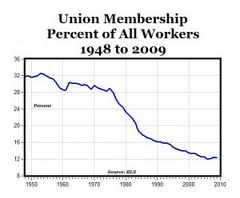
Just under 18% of Rhode Islanders are represented by labor unions; it was 26% in 1964, and 22.5% in 1984.  In other words, the trend is the same here as everywhere:  downward.

The national trend, since the passage of Taft-Hartley in 1947:

The breakdown by state, since 1964:


There are many reasons for this decline.  Economic change, the shift of American industry and population to the South and Southwest, the restrictive nature of our labor laws, McCarthyism and red-baiting, poor and sometimes corrupt union leadership.  Unions were also victims of their own success; by helping to create the post-war middle class, many of their white constituents (and their children) decamped for the suburbs, and resisted seeing the struggles of the black (and eventually, Latino) working class they left behind as similar to their own, rather than a threat.  In other words, the American original sin of race infected -- had long infected -- even its most transformational social movements and institutions.  Perhaps our individualistic and materialistic culture has also become indifferent -- even hostile -- to the sensibility of solidarity, upon which the labor movement depends.

All of these things have mattered, but the most important cause of labor's decline, ultimately, has been the political success of corporate resistance, particularly since the early 1970s (on this, read Elizabeth Fones-Wolf and Jefferson Cowie, as well as Jacob Hacker and Paul Pierson).  Many of my peers (and my students) seem to assume that unions are a thing of the past, and that the victories they won -- like the end of slavery and the enfranchisement of women -- are now written in stone, and we can move on.  In other words, progress gave rise to unions, and then tossed them on the scrap heap of history (with the American Anti-Slavery Society, The Women's Party, the NAACP, and affirmative action) when they had fulfilled their role.  Events in Wisconsin (and, of course, the Occupy movement) may have finally awoken at least some of these folks to the possibility that if the ship of history has moved in this direction, it may be because someone is steering it there.

As a labor historian and former organizer, I also had a hard time getting my head around the idea that unions could actually be too powerful -- both because I can't imagine that being the case anywhere in 21st America, and because I can't imagine that being a negative thing, on balance.  I would love to have to grapple with that problem, here and nationally.

Walter Reuther, vampire-killer...or life raft?

So why does the decline of labor matter, in Rhode Island and nationally?

Well for one, it is hard not to be struck by the apparent correlation between the decline of union power, and the emergence of increasing inequality, economic insecurity, and wage stagnation for large portions of our population since the early 1970s.  From 1940 until the early 70s, the economic benefits of the productivity of the American economy were widely shared, leading to what economists have called 'the Great Convergence':  a shrinking of income inequality, combined with a strong and steady increase in the standard of living for the vast majority of the population.

But since then?


So where did all that money go?  Did it go to those wealth-sucking and budget-busting public employees that Scott Walker keeps going on about?  Did those tax-and-spend liberals devour all of it, so they could rain manna on their special interest constituencies?

Um, no.


Is it any wonder why vampire stories seem to have captured the cultural zeitgeist?

Thursday, January 05, 2012

Social mobility: the decline of American exceptionalism

Very good overview of the issue of social mobility in the U.S. in the Times today, by the always thoughtful Jason DeParle. 


For a graphic comparing social mobility in the U.S. and Denmark, go here (tried to reproduce it here, but couldn't make it fit).


The piece is quite balanced, and notes that while arguments can be made for the moral, political and economic irrelevancy of inequalities of income, data indicating a lack of social mobility constitute a much more consequential challenge for conservatives.  DeParle makes it clear that while scholars do argue over the data and their interpretation, the vast preponderance of research on mobility shows us two things:  that mobility in the U.S. is lower than most people think, and that other comparably wealthy countries are much more mobile than we are.  He doesn't note -- but I will -- another relevant fact:  Canada and most of Western Europe and Scandinavia not only have more mobility within and across generations.  The consequences of not moving up -- or of falling -- aren't nearly as dire as they are in the U.S.


The only real justification for the extraordinary inequalities of wealth that exist in the US today, is that while resources aren't distributed equally, opportunities are. But this is clearly not true, and hasn't been for quite some time. It is my sense that, barring definitive action by government at all levels, we are only at the beginning of a massive collapse of the opportunity structure in the US.  


The tragedy of this is that over the last decade we have come to a greater understanding of how inequality is reproduced across generations, particularly among the very young -- and because of this research, we also have a pretty good sense of what the most effective policy instruments might be.  But inequality generates a politics designed to protect privilege (surely this is the irony of the 'Tea Party,' as Thomas Frank argues in his new book), making it almost impossible for us to truly grapple with all of this as a nation.

Friday, July 01, 2011

Wisdom on inequality from the belly of the beast

This, from Bloomberg today:


Federal Reserve Governor Sarah Bloom Raskin told the New America Foundation that economic inequality, caused by stagnating incomes for most Americans and rapid growth in wealth for the richest 1 percent, is hindering the U.S. economic recovery. She described income inequality as "destabilizing," because it "undermines the ability of the economy to grow sustainably and efficiently." “Finding ways to help more Americans safely grow their incomes and net worth in real terms arguably diminishes the destructive influence of income inequality by giving everyone a more secure footing in the economy and the same kind of flexibility and choice available to the more affluent,” Raskin said.


Raskin is hardly the first mainstream economist to see a connection between inequality and today's economic stagnation (Raghuram Rajan got there first) but she is the first one in a policy-making position that I've seen. Wage stagnation, income inequality and economic insecurity have of course dominated the lives of most American families for decades now, long before the Great Recession.  Indeed, one could argue (as Rajan and Robert Reich have) that the inequality may have played a major role in causing the economic downturn.  There is little doubt, however, that it continues to hamper our ability to get out of it.


Unfortunately, the best responses to the effects of inequality and income stagnation on economic demand -- Keynesian fiscal policy, a strengthened safety net, a revived labor movement, and so forth -- are unavailable in the present political environment.  The Fed can do little on its own, though one hopes that Raskin's clarion call is heard over on Capitol Hill...and in the White House, as the days tick down toward debt ceiling day.

Tuesday, June 28, 2011

how inequality reproduces itself, and why policy matters


Nancy Folbre, economist at UMass-Amherst, has a thought-provoking piece on yesterday's NY Times Economix Blog, "Born to Lose: Health Inequality at Birth."
In the post, she summarizes some of the work by Princeton's Janet Currie and others, on the relationship between health disadvantages at birth, and future economic well-being and educational achievement.  


One of the most fascinating and important interdisciplinary research agendas of the last decade has been the effort by economists, sociologists and epidemiologists to understand how inequality is reproduced in the developed world, and how/why inequality matters.  To the extent that I have any optimism left about the possibility of a more just America, it is based on my reading of this literature.  Of course, as a theoretical and empirical matter this question (inequality) is hardly new; the reproduction of capitalist class relations has generated some of the most insightful intellectual work of the past 150 years, starting with Marx.


But this work -- typified for me by the vital work of Richard Wilkinson and Kate Pickett in Great Britain, and James Heckman, Thomas Shapiro/Melvin Oliver, and Annette Lareau in the US -- is different.  It isn't theoretical, at least not primarily.  Rather, it seeks to understand how inequality is partly rooted in such things as pre-natal and and infant health, the environmental factors shaping cognitive development, social capital, nutrition, exposure to violence, the correlation of all of these things with place, and the overall income and wealth inequality in the society in which children are raised.  It acknowledges the vital importance of resources, of course (family income and wealth), and the power that shapes their distribution.  But it also attempts to show us why and how a lack of wealth and income matters -- how it shapes places, families, bodies, minds, and ways of seeing the world.  In the context of the US, as I have argued elsewhere (and will argue further here in the future), the ubiquity of racial and economic segregation also appears to profoundly shape all of these things, and thus the distribution of primary social goods.  It is (and will be) my contention that untying the knot of metropolitan segregation is likely to unravel many more things.  But more on that later.


I see 3 absolutely vital (and interrelated) insights coming from this stuff:
1.    International comparisons (see Wilkinson's work with Kate Pickett) reveal that income inequality within  developed societies tends to have enormous impacts on health, culture and quality of life for all citizens, not just the least privileged.  In other words, citizens living in societies with great inequalities of income tend to have worse outcomes in terms of mental health, obesity, social trust, exposure to violence, life expectancy, and social mobility.  The statistical correlations are simply too strong and consistent not to be at least in part causative.  The graph below comes from Wilkinson and Pickett, and can be found on their website.  Note the strong relationship between income inequality and infant mortality, which appears to be recursive -- in other words, inequality leads to high infant mortality rates, which tends to reproduce inequality, etc.


Infant Mortality


2.  Policy matters, because those developed nations with less inequality (and the improved quality of life that seems to stem from it) are more equal because they have chosen it -- its not culture that matters here, or economic growth.  And just as the circle of inequality is vicious, the circle of equality is virtuous:  in so far as a society chooses to be more equal, it tends to be more willing to make decisions (even sacrifices) that will benefit the collective good.

Friday, June 24, 2011

Stories from the Kitchen Table

The US Senate Committee on Health, Education, Labor and Pensions, chaired by Sen. Tom Harkin (D-IA), gathered some fascinating testimony yesterday.

As part of an ongoing series of hearings on "Stories from the Kitchen Table: How Middle Class Families Are Struggling to Make Ends Meet," Harkin gathered together experts and ordinary folks to talk about the economic insecurity dominates the lives of so many American households.

You can watch the testimony (its about an hour long) here, and get written versions of the testimony.  The testimony of Jared Bernstein (Joe Biden's former economic adviser) is particularly worthwhile -- its one of the best short and sweet summaries of the economic predicament of the American middle class I've seen.

Conservatism, taxes and the defense of inequality

As Ezra Klein points out today, GOP leadership in Congress continues to stubbornly resist tax increases as a legitimate part of any bi-partisan deficit reduction package.  "President Obama needs to decide between his goal of raising taxes, or a bipartisan plan to address our deficit," said Senators McConnell and Kyl in a joint statement. 


One wonder where all of this will wind up.  The GOP appears to be wrong on both the politics and policy. Polls consistently show that most Americans accept that any deficit reduction package will have to include cuts and revenue increases -- with the overwhelmingly majority of them favoring increased taxes on the wealthy.  It is hard not to think that the GOP's baseline position is defined not by fiscal austerity or a philosophical commitment to small government, but by opposition to wealth redistribution and the desire to protect the economics interests of the privileged.  


In a must read article in Democracy, Jonathan Chait dug deeply into the 'taxophobia' that seems to uniquely define American conservatism in this historical moment.  The conservative movement's 
embrace of taxophobia is probably the most important development in American political life over the last three decades. It is the one quality that most distinguishes American conservative elites from conservative elites in other countries. They’re more likely to question climate science, more sanguine about people dying for lack of health insurance, and less xenophobic (which is rather nice). But above all—far above all—they hate taxes.
Political science research indicates that this taxophobia has been the prime driver of the growing partisanship on economic and redistribution issues among our political elites.  More profoundly, Chait argues, conservative taxophobia has redefined the terms of the political debate.  Democrats are the new fiscal conservatives, while the old fiscal (Keynesian) liberalism stands at the fringes of our economic discourse.  Despite three decades of evidence contradicting supply-side economics, its hold on the Republican Party has only strengthened.


Chait again:
The Republican Party inhabits an otherworldly new realm that even the staunchest right-wingers of a generation before could scarcely have imagined. As the two parties trade power back and forth, the ideological basis for economic policy ping-pongs between the old right and a loopy kind of far-right. Periods of Republican governance have grown increasingly disastrous, while periods of Democratic governance are largely consumed with staving off fiscal collapse.
Clearly taxophobia in the GOP persists despite the empirical evidence.  Outside the rarified air of the Republican leadership, there is little questioning of the role that tax cuts have played in getting us to this point.  As Lori Montgomery wrote when analyzing the component parts of our shift from surpluses to deficits, "the biggest culprit, by far, has been an erosion of tax revenue triggered largely by two recessions and multiple rounds of tax cuts. Together, the economy and the tax bills enacted under former president George W. Bush, and to a lesser extent by President Obama, wiped out $6.3 trillion in anticipated revenue."  Simply letting the Bush tax cuts expire on schedule (or paying for any portions that policymakers decide to extend) would stabilize the debt-to-GDP ratio for the next decade.  The Center for Budget and Policy Priorities provides us with this useful chart:

 Tax Cuts, Wars Account for Nearly Half of Public Debt by 2019


Clearly, there is a political and ideological commitment to taxophobia in today's GOP, quite distinct from whether there is any evidence for its effectiveness as policy -- indeed, policy may very be irrelevant.  It is hard for anyone with even a basic knowledge of the economic history of the US in the past 3 decades to maintain -- as the GOP does today -- that tax cuts will both generate revenue and put a cap on government expenditures.  So why the taxophobia?  Other than in the early 80s, perhaps, one cannot argue that pure vote pandering is the cause, particularly because the sorts of tax cuts the Republicans have consistently favored (and enacted) have been heavily skewed toward the top of the income ladder.