About Me

I am Associate Professor and Chair of the History Department at the University of Massachusetts-Dartmouth. I am also the Academic Director of the Clemente Course in the Humanities, in New Bedford MA. Author of "Social Security and the Middle Class Squeeze" (Praeger, 2005) and the forthcoming "Saul Alinsky the Dilemma of Race in the Post-War City" (University of Chicago Press), my teaching and scholarship focuses on American urban history, social policy, and politics. I am presently writing a book on home ownership in modern America, entitled "Castles Made of Sand? Home Ownership and the American Dream." I live in Providence RI, where I have served on the School Board since March 2015. All opinions posted here are my own.
Showing posts with label liberalism. Show all posts

Tuesday, June 05, 2012

Solidarity, For Now? Liberalism and the Many Costs of Labor's Decline

Great piece today by Providence's own Joe Nocera, on what the decline of organized labor has done to the American Dream -- and a good day for it, too, as Scott Walker's revolutionary (non-union) train chugs into the Madison Station.

When I moved to RI in 2003 from Washington, I was rather stunned to hear many of my liberal friends repeat the media meme that organized labor was too powerful in the Ocean State [note:  I will use the term 'liberal' rather than 'progressive,' because in my experience people on the left my age and younger tend to substitute the latter for the former, without knowing the meaning of either].

My surprise stemmed from two sources:  the extent to which liberals of my generation (I'm 45) underestimate the vital importance of unions for the enactment and preservation of liberal measures and attitudes, and the extent to which these same liberals had completely misread the situation in their own state.

On the latter, read Scott McKay's brilliant take-down of the 'union rules RI' meme on NPR the other day.  As he notes, would the tax equity bill have gone down to defeat if unions truly ruled the roost?

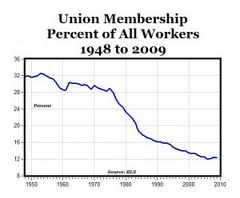
Just under 18% of Rhode Islanders are represented by labor unions; it was 26% in 1964, and 22.5% in 1984.  In other words, the trend is the same here as everywhere:  downward.

The national trend, since the passage of Taft-Hartley in 1947:
The breakdown by state, since 1964:


There are many reasons for this decline.  Economic change, the shift of American industry and population to the South and Southwest, the restrictive nature of our labor laws, McCarthyism and red-baiting, poor and sometimes corrupt union leadership.  Unions were also victims of their own success; by helping to create the post-war middle class, many of their white constituents (and their children) decamped for the suburbs, and resisted seeing the struggles of the black (and eventually, Latino) working class they left behind as similar to their own, rather than a threat.  In other words, the American original sin of race infected -- had long infected -- even its most transformational social movements and institutions.  Perhaps our individualistic and materialistic culture has also become indifferent -- even hostile -- to the sensibility of solidarity, upon which the labor movement depends.

All of these things have mattered, but the most important cause of labor's decline, ultimately, has been the political success of corporate resistance, particularly since the early 1970s (on this, read Elizabeth Fones-Wolf and Jefferson Cowie, as well as Jacob Hacker and Paul Pierson).  Many of my peers (and my students) seem to assume that unions are a thing of the past, and that the victories they won -- like the end of slavery and the enfranchisement of women -- are now written in stone, and we can move on.  In other words, progress gave rise to unions, and then tossed them on the scrap heap of history (with the American Anti-Slavery Society, The Women's Party, the NAACP, and affirmative action) when they had fulfilled their role.  Events in Wisconsin (and, of course, the Occupy movement) may have finally awoken at least some of these folks to the possibility that if the ship of history has moved in this direction, it may be because someone is steering it there.

As a labor historian and former organizer, I also had a hard time getting my head around the idea that unions could actually be too powerful -- both because I can't imagine that being the case anywhere in 21st America, and because I can't imagine that being a negative thing, on balance.  I would love to have to grapple with that problem, here and nationally.

Walter Reuther, vampire-killer...or life raft?

So why does the decline of labor matter, in Rhode Island and nationally?

Well for one, it is hard not to be struck by the apparent correlation between the decline of union power, and the emergence of increasing inequality, economic insecurity, and wage stagnation for large portions of our population since the early 1970s.  From 1940 until the early 70s, the economic benefits of the productivity of the American economy were widely shared, leading to what economists have called 'the Great Convergence':  a shrinking of income inequality, combined with a strong and steady increase in the standard of living for the vast majority of the population.

But since then?


So where did all that money go?  Did it go to those wealth-sucking and budget-busting public employees that Scott Walker keeps going on about?  Did those tax-and-spend liberals devour all of it, so they could rain manna on their special interest constituencies?

Um, no.


Is it any wonder why vampire stories seem to have captured the cultural zeitgeist?

Saturday, July 02, 2011

Cynicism, government, and subsidiarity


I cross-posted my piece on "Penny-wise and (Rand) Paul Foolish" on RIFuture.org yesterday.  The article below is a response to a commenter, who raised 2 points:
1.  Given the functioning of our public school system in recent decades, isn't my call for universal public pre-k overly optimistic, if not misinformed
2.  Rather than giving the IRS more authority -- since government does very few things well anyway -- should we just simplify the tax code? 
First, your point and mine with regard to the IRS aren't incompatible.  I'm all for simplifying the federal tax code.  It would cut down on abuse, and make enforcement easier.  Unfortunately, pols from across the political spectrum share the responsibility for having made the code so immensely complicated.  


Suzanne Mettler has a really important article in the latest issue of the Washington Monthly, in which she points out how tax expenditures and credits have essentially substituted for other forms of policy in recent decades.  My sense is that my fellow liberals are particularly guilty of this.  Unable to win the argument politically for a stronger and more expensive social safety net, or more authoritative regulations, tweaking the tax code seems to have become the apparently 'cost-free' way to make policy that liberals, moderates and many conservatives can agree on.  The problem, of course, is that writing the tax code with a dry erase marker means that someone else can re-write it...and when regs and codes get re-written, it is usually to the benefit of the privileged, outside of the light of public scrutiny.  The tax code is also an awkward and often inefficient tool for making social policy.
 If we simplify -- and lord knows there are lots of ways to do that -- we can return the tax code to its primary purpose, which is of course to raise revenue.  I don't think all purposeful taxes are bad, far from it (I like the estate tax, and a carbon tax, and many others), but simpler would be better...as long as the system retains its progressive nature.  Right now, in terms of actual taxes paid, the American tax system (federal income, payroll, state, property) has lost most of its progressivity.  This is in part responsible for the massive expansion of inequality in this country in recent decades.
Second, your cynicism about government (can we pull off public pre-k; govt spending is nearly always wasteful) was precisely what I was aiming at in my post.  I see the same sentiment from all sides of the political spectrum.  I think that kind of cynicism about government is factually inaccurate, politically dangerous, and -- to be frank -- intellectually lazy.  I don't want to get into public education too much here, but one gets a little tired of the constant laments about the poor quality of the system from liberals and conservatives alike.  The fact of the matter is that the system works well for the vast majority of American school kids.  Where it falls short is in the education of the poor, and students of color.  While obviously some of that is connected to flaws in how we've structured school governance and finance (particularly in cities), as much if not more of it stems from the fact that we have a lot of child poverty in this country, and that we geographically concentrate so much of that poverty, particularly among people of color.  The failures of our public schools are failures of political will, more than they are failures of government as such (in other words, the 'public' part of 'public schools' isn't the issue).
So much of our public discourse has shifted in this direction in recent decades.  One consequence, which I lament even if you don't, is the virtual elimination of liberalism from mainstream political reality.  Another, which we are discovering right now on the debt ceiling, the deficit, the Great Recession, global warming, etc, is that we have rendered ourselves incapable as a nation of grappling with the biggest issues we face.  Other than Obama's health care bill, I find it hard to name any large-scale issue that our federal government has fully addressed since the early 70s environmental legislation.  My point, in the end, was that people across the political spectrum should be able to agree on a basic point (one finds this consensus in other wealthy countries):  that government has certain basic responsibilities, and that progressive forms of taxation are the best way to pay for them. 
Personally, I'm one of those rare left-liberals who finds the Catholic notion of 'subsidiarity' convincing.  American conservatives often argue that subsidiarity is simply a call for smaller government, and more room for the marketplace.  I'm no theologian (I'm not even Catholic), but I think this is a misunderstanding.  It does insist that as many decisions as possible should be left to the local level, where citizens are more likely to be directly engaged.  But at its core is an ethical imperative for communal, institutional or governmental action to create the social conditions necessary to the full development of the individual, family and community.  That means larger and more interventionist government where its appropriate, with a preference for decentralization...but only if that best serves the ethical imperative. 
If American conservatives want to criticize poor government, fine -- I'm with them on that.  But when it slides into criticism of governance itself, they lose me. 

Wednesday, June 29, 2011

Penny-wise, (Rand) Paul foolish -- or, why government often matters

It appears, at times, that American conservatives seem to even deny the possibility that government spending or regulation might actually save money -- either save the government money (a secondary consideration) or save the country money (presumably, the primary goal).  As I noted yesterday, there is now ample empirical evidence that environmental regulation (along with Medicaid) has decreased infant mortality; for decades now, scholars have argued that the 1944 G.I. Bill more than paid for itself as well.  Spending large sums of public money on high quality universal pre-school would reduce all sorts of other economic and social costs, both for the government and for the nation as a whole.  There are, of course, far too many other examples to recount here.

It should be said that cost-benefit analysis should not be the only rubric for measuring whether a government program, tax or regulation is worthwhile.  Take the estate tax, for example:  as Andrew Carnegie and Theodore Roosevelt argued early in the 20th century, the goal was in large part to break up concentrated wealth.  "The man of great wealth owes a particular obligation to the State because he derives special advantages from the mere existence of government," Roosevelt told Congress in 1906.  "The prime object should be to put a constantly increasing burden on the inheritance of those swollen fortunes which it is certainly of no benefit to this country to perpetuate."  The revenue it generated was a side benefit.  It is important for liberals to continue to stress that in most cases, most of the time, government works.  Post-New Deal liberalism was founded on 2 core ideas, both of which made sense to many Americans who came of age in the 30s, 40s and 50s:

1)  that disaster (economic, natural, medical) can strike any of us at any time, so we should be willing to share or pool risks; and
 2) that we can and should collectively build and maintain common institutions and goods through the instrument of government.  Like American liberalism more generally, these two assumptions are as conservative as they are liberal -- this explains much of their appeal, in fact.

While one can translate those two core ideas into a purely economic calculus, I think this misunderstands them.  More to the point, it ignores the fact that there are other justifications for government action that are valid as well:  justice, for example.  Public or common goods must be created, protected and enhanced, since private action is unlikely to do so.  And this must be done even if we cannot sufficiently calculate or determine a monetary benefit.  There is a danger, a slippery slope for liberals (and the country) in arguing that only a 'return on investment' constitutes a valid rationale for state action.  For one, if a healthy return cannot be demonstrated, it feeds public resentment of taxation (see my taxaphobia post of a few days ago).

One result has been a surprisingly bi-partisan denigration (and de-funding) of the IRS over the past decade or so.  Little money has been or can be saved by trimming the IRS budget.  Indeed, one can convincingly argue that a big chunk of the present deficit could be erased simply by beefing up IRS capacity, so it can go after individuals and corporations that aren't paying their fair share.   The Government Accounting Office (GAO) recently estimated that approximately $330 billion in federal taxes had never been paid as of the end of fiscal year 2010.  A good chunk of the tax evaders are individuals with "substantial personal assets" including multi-million-dollar homes and luxury cars, the GAO reported.   For every dollar the IRS spends on audits, liens, and property seizures, the government brings in more than $10.  If we spend less on IRS enforcement, as Republicans demand (and to which Democrats too often acquiesce), it costs us.  Obviously it costs our government revenue, but there is another cost, too:  it slowly undermines public faith in the rule of law.  Surely this is an odd position for conservatives to take.  A society that cannot tax itself, and that undermines popular belief in the effectiveness of government, will generate a politics that slowly devours itself -- like an autoimmune disease.  We have certainly reached this point now, haven't we?

The common assumption that any dollar spent by government is inherently wasteful simply flies in the face of evidence, historical and contemporary.

In keeping with this theme, Steven Benen of Washington Monthly usefully points us toward an exchange between Sen. Bernie Sanders (I-VT), Sen. Al Franken (D-MN) and Sen. Rand Paul (R-KY) earlier this week, during a subcommittee hearing on funding the existing Older Americans Act.  Sanders made the point that spending $2 billion to prevent hunger among the elderly should be considered an investment, because it would ultimately save money (for the feds, and overall) on health care and nursing home costs.

Paul was incredulous that any federal program or regulation could be considered an investment.  "It's curious that only in Washington can you spend $2 billion and claim that you're saving money.  The idea or notion that spending money in Washington is somehow saving money really flies past most of the taxpayers."

The brief exchange is worth watching:

Thursday, August 02, 2007

Two Cheers for Liberalism (August 2007)

The article below was originally posted on The Public Humanist, a blog published by Mass Humanities. I am an infrequent writer on the blog. Enjoy!

So what is American liberalism, and how (if at all) has it changed since the 60’s? Is it truly as irrelevant to our times as the "re-branding" of Senator Clinton and others would seem to indicate? In its broadest meaning, the classical political liberalism that emerged in the 17th and 18th centuries – based upon constitutional government and individual rights – is an intellectual heritage shared by liberals and conservatives alike. It was in the late 19th and early 20th centuries, heralding the emergence of corporations and the rapid expansion of wage labor, when today’s liberals and conservatives began to part ways.

The essential difference revolved around their approach to what was called the “social question”: what is to be done about the poverty and insecurity generated by the new economic and social order? Or, to put it somewhat differently, is the unequal distribution of economic power a threat to liberal government? Future conservatives thought freedom was best protected by property rights, contract, and a limited government, and generally denied the existence and relevance of the whole idea of “economic power.” Pushed by social movements as well as theological developments (the Social Gospel for Protestants, and the papal encyclical Rerum Novarum for Catholics), future liberals began to articulate a broader definition of effective freedom, a more robust conception of power, a moral need for social solidarity, and a new role for government.

Modern American liberalism came into its own under Franklin Delano Roosevelt in the thirties and forties. The commonly told political story is that liberalism triumphed in 1936, and in the post-war era shaped a politically dominant “consensus” that wasn’t shaken until the late sixties, liberalism’s “high water mark.” Liberals were never really as dominant as people think; conservatives had limited liberals from the very beginning of what’s understood as the liberal/conservative dichotomy, not suddenly in the 60s. The New Deal coalition patched together by Franklin Roosevelt in 1936 was limited from its inception by the political and racial conservatism of the apartheid South, as well as by a conservative business class that became increasingly active politically in the Cold War era. The ability of liberalism to grapple with the two central dilemmas of 20th century American life – the social question, and race – was severely circumscribed by steady opposition from the very beginning. While one can certainly criticize the limits of liberalism’s reach on these two issues (particularly the latter), one must also properly understand the limits of its grasp.

Pushed by the reborn labor movement, Franklin Roosevelt provided American liberalism’s answer to the social question. Liberalism borrowed its moral sensibilities from the seemingly “unliberal” notions of solidarity and interdependence, but deployed them in the service of liberalism’s essential concern: freedom. Because of the Great Depression, Roosevelt argued, “we have been compelled to learn how interdependent upon each other are all groups and sections of the population of America.” This interdependence convinced Roosevelt that “true individual freedom cannot exist without economic security and independence,” because “necessitous men are not free men.” In an economy dominated by “the often intangible forces of giant industry,” Roosevelt argued in 1938, a person’s “individual strength and wits” cannot guarantee security or freedom any more. More than anything else, Roosevelt argued, Americans want “work, with all the moral and spiritual values that go with it; and with work, a reasonable measure of security” for them and their families. Modern freedom required an opportunity to make a decent living – not just enough to live by, but also “something to live for,” in Roosevelt’s words. American liberalism was a public philosophy of both individual freedoms and social solidarity. Not only were these things not mutually exclusive; they depended upon one another.

The imbalance of economic power in American society, Roosevelt insisted, had led a growing number of citizens to believe that liberty was no longer real. Government must do more than just protect the right to vote; it must also “protect the citizen in his right to work and his right to live?freedom is no half-and-half affair.” This would not deny individual responsibility; rather, it would define it in a way that seemed reasonable and fair to people in the real world. Freedom from desperate conditions – security – was thus an essential supplement to political freedom. This was an old idea, deeply rooted in the nation’s founding. It was based on the old republican notion of freedom as "self-government," as articulated by Paine, Jefferson, and many others. The needy lack the independence and security to be self-governing, and thus they are not free citizens.

Roosevelt’s answer to the social question became the centerpiece of a powerful public philosophy that dominated American liberalism into the 1960s. Indeed, throughout the developed West (and Japan) in the decades after World War II, the notion of a “social contract” that democratized wealth and opportunity became widespread, contributing to economic expansion and the growth of a stable and prosperous middle-class. Welfare states were established, embodying a generation’s hopes for universal economic security and protection from the worst of life’s hazards. In the US the G.I. Bill typified this use of Hamiltonian means to Jeffersonian ends, helping to spark a massive expansion of home ownership and college attendance. Economic, tax and social policy, investments in infrastructure (highways, education, and especially housing), and the growth in collective bargaining, were primary factors that helped to broadly distribute the nation’s unprecedented prosperity. This, in turn, provided widespread access to property ownership, education, and mass consumption for millions of white Americans.

Today, liberalism no longer concerns itself with the "social question." Indeed, it has not done so for decades now. It is this, as much as anything, that lends credence to many of the criticisms directed at liberals from all sides. It isn’t that liberalism lacks any kind of moral core, as conservatives assert; nor is it overly individualistic and rights-based, as more friendly critics contend. For much of the 20th century American liberalism was a public philosophy grounded in social solidarity and a moral (and even theological) critique of inequalities of power.

There are many reasons why the social question has dropped out of American political discourse. One could argue, for example, that the institutional and geographic underpinnings of social solidarity have greatly eroded in recent decades, as white Americans decamped to the suburbs, our older cities imploded under the pressure of economic change and racialized neglect, and unions lost their radical edge and then their membership. Only a militarized patriotism seems capable of successfully evoking solidarity today. One could argue that the inability (and frequent unwillingness) of liberals to overcome white resistance to a solidarity that fully included black Americans generated a chastening backlash against all active government. The growing political power of corporations has also played a role, joining with conservatives to fetishize “free” markets and deny that government has any meaningful role to play in shaping the material preconditions of effective freedom.

Historian Robert Dallek cites a comment someone made to Eleanor Roosevelt shortly after her husband’s death: “I miss the way your husband used to speak to me about my government.” Government, even metaphorically, is not the enemy; it is, after all, “our” government. When Senator Clinton runs away from liberalism, she runs away from this bit of hard-won political wisdom. A politics that dissolves the personal connection between citizen and government in favor of an adversarial one threatens to undermine our capacity for discussing and meeting common needs. Like an autoimmune disease, an unreflective hostility to government threatens to turn the protective forces of the body politic against the body itself. As Franklin Roosevelt eloquently put it in 1936, “better the occasional faults of a Government that lives in a spirit of charity than the consistent omissions of a Government frozen in the ice of its own indifference.”