Great piece
today by Providence's own Joe Nocera, on what the decline of organized labor has done to the American Dream -- and a good day for it, too, as Scott Walker's revolutionary (non-union) train chugs into the Madison Station.
When I moved to RI in 2003 from Washington, I was rather stunned to hear many of my liberal friends repeat the media meme that organized labor was too powerful in the Ocean State [note: I will use the term 'liberal' rather than 'progressive,' because in my experience people on the left my age and younger tend to substitute the latter for the former, without knowing the meaning of either].
My surprise stemmed from two sources: the extent to which liberals of my generation (I'm 45) underestimate the vital importance of unions for the enactment and preservation of liberal measures and attitudes, and the extent to which these same liberals had completely misread the situation in their own state.
On the latter,
read Scott McKay's brilliant take-down of the 'union rules RI' meme on NPR the other day. As he notes, would the tax equity bill have gone down to defeat if unions truly ruled the roost?
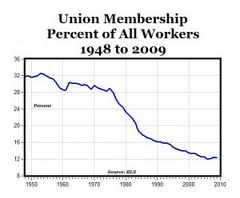
Just under 18% of Rhode Islanders are represented by labor unions; it was 26% in 1964, and 22.5% in 1984. In other words, the trend is the same here as everywhere: downward.
The national trend, since the passage of Taft-Hartley in 1947:
The breakdown by state, since 1964:
There are many reasons for this decline. Economic change, the shift of American industry and population to the South and Southwest, the restrictive nature of our labor laws, McCarthyism and red-baiting, poor and sometimes corrupt union leadership. Unions were also victims of their own success; by helping to create the post-war middle class, many of their white constituents (and their children) decamped for the suburbs, and resisted seeing the struggles of the black (and eventually, Latino) working class they left behind as similar to their own, rather than a threat. In other words, the American original sin of race infected -- had long infected -- even its most transformational social movements and institutions. Perhaps our individualistic and materialistic culture has also become indifferent -- even hostile -- to the sensibility of solidarity, upon which the labor movement depends.
All of these things have mattered, but the most important cause of labor's decline, ultimately, has been the political success of corporate resistance, particularly since the early 1970s (on this, read Elizabeth Fones-Wolf and Jefferson Cowie, as well as Jacob Hacker and Paul Pierson). Many of my peers (and my students) seem to assume that unions are a thing of the past, and that the victories they won -- like the end of slavery and the enfranchisement of women -- are now written in stone, and we can move on. In other words, progress gave rise to unions, and then tossed them on the scrap heap of history (with the American Anti-Slavery Society, The Women's Party, the NAACP, and affirmative action) when they had fulfilled their role. Events in Wisconsin (and, of course, the Occupy movement) may have finally awoken at least some of these folks to the possibility that if the ship of history has moved in this direction, it may be because someone is steering it there.
As a labor historian and former organizer, I also had a hard time getting my head around the idea that unions could actually be
too powerful -- both because I can't imagine that being the case anywhere in 21st America, and because I can't imagine that being a negative thing, on balance. I would love to have to grapple with
that problem, here and nationally.
Walter Reuther, vampire-killer...or life raft?
So why does the decline of labor matter, in Rhode Island and nationally?
Well for one, it is hard not to be struck by the apparent correlation between the decline of union power, and the emergence of increasing inequality, economic insecurity, and wage stagnation for large portions of our population since the early 1970s. From 1940 until the early 70s, the economic benefits of the productivity of the American economy were widely shared, leading to what economists have called 'the Great Convergence': a shrinking of income inequality, combined with a strong and steady increase in the standard of living for the vast majority of the population.
But since then?
So where did all that money go? Did it go to those wealth-sucking and budget-busting public employees that Scott Walker keeps going on about? Did those tax-and-spend liberals devour all of it, so they could rain manna on their special interest constituencies?
Um, no.
Is it any wonder why
vampire stories seem to have captured the cultural zeitgeist?