About Me

I am Associate Professor and Chair of the History Department at the University of Massachusetts-Dartmouth. I am also the Academic Director of the Clemente Course in the Humanities, in New Bedford MA. Author of "Social Security and the Middle Class Squeeze" (Praeger, 2005) and the forthcoming "Saul Alinsky the Dilemma of Race in the Post-War City" (University of Chicago Press), my teaching and scholarship focuses on American urban history, social policy, and politics. I am presently writing a book on home ownership in modern America, entitled "Castles Made of Sand? Home Ownership and the American Dream." I live in Providence RI, where I have served on the School Board since March 2015. All opinions posted here are my own.
Showing posts with label conservatism. Show all posts

Friday, November 09, 2012

Ned Flanders, Mitt Romney and liberal schadenfreude

"The billionaire donors I hear are livid ... There is some holy hell to pay. Karl Rove has a lot of explaining to do ... I don't know how you tell your donors that we spent $390 million and got nothing," - A "Republican operative," to HuffPo.
In a 1991 episode of "The Simpsons," Ned Flanders opened a store at the mall selling everyday objects for left-handed people.  His next door neighbor Homer, typically, hoped the store would fail.  When it did, Homer's daughter Lisa sought to stretch her father's emotional intelligence a little bit:
Lisa:  Dad, do you know what schadenfreude is?

Homer:  No, I don't know what 'shaden-frawde' is [sarcastic].  Please tell me, because I'm dying to know.

Lisa:  It's a German term for 'shameful joy,' taking pleasure in the suffering of others.

Homer:  Oh, come on Lisa.  I'm just glad to see him fall flat on his butt! [getting mad]  He's usually all happy and comfortable, and surrounded by loved ones, and it makes me feel...what's the opposite of that shameful joy thing of yours?

Lisa:  Sour grapes.

Homer:  Boy, those Germans have a word for everything!


At times over the past decade, I think my fellow liberals have obsessed a bit too much over the antics and extremism of the conservative media echo chamber.  People like Ann Coulter, Sean Hannity and Glenn Beck spew forth some kind of incendiary bile, twisting the panties of progressives into knots of righteousness indignation...while the plutocrats who actually run the Republican Party (and said media echo chamber) quietly go about their business.

That said, the results on Election Night seem to have turned the right-wing's entire public establishment into a burning ball of incandescent and inchoate rage.  And while Montesquieu is probably right that schaudenfreude is a kind of cowardice, I don't think that applies when the pleasure one takes at the suffering of others is aimed at the comfortable and powerful.  Indeed, one of the most morally repugnant aspects of what passes for American conservatism these days is that its experience of 'shameful joy' tends to manifest itself in a self-righteous and sadistic satisfaction in the struggles of the afflicted.

In an unapologetic elitism, in other words.

Laughing at the failures and foibles of the high and hubristic is (or should be) the very essence of humor in the age of mass democracy.

So, f*ck'em.  If they are stinging from a gigantic karmic bitch-slap, I see no reason for a lefty like me not to groove on the sound.  I'll get back to the thoughtful analysis of what the election of 2012 tells us about our country and its future in other posts in the coming weeks.  But for now, the only responsible thing to do in the face of absurdity -- and the faintest glimpses of an unexpected cosmic justice -- is to laugh your ass off.

And since I'm using funny foreign words in this post, let's pick something in French too, since that'll make them squirm even more.  The phrase 'l'esprit d'escalier' literally means 'the spirit of the staircase."  But in common usage, it refers to the exact moment a person comes up with a clever retort to an embarrassing insult, the sort of thing for which Churchill, Wilde and Parker were renowned.  I don't know about you, but those of us in the 'reality-based' community have had to put up with a wide variety of insults for years now -- to our morality, our patriotism, and our intelligence. 

So what's the clever retort here?

Well, I'm just going to point to the scoreboard.  And give you what's below, for your delectation.  Please note that no mockery or misinterpretation of what follows is necessary.  Just verbatim quotations and images, demonstrating a breathtaking kind of cognitive dissonance, as privileged white males sputter and choke in a desperate refusal to accept the epistemic change that confronts them.

So please know, my fervid conservative friends, that I am temporarily suspending the empathic sensibility that generally informs most of us on the left.  I am not laughing with you, in other words, since you seem capable of neither doubt nor self-deprecation. 

I am laughing at you.  You are welcome to join me.


First, of course, there was the willful denial in the days leading up to the election of the slowly accumulating empirical evidence that Romney wasn't going to have a good night.  This started with the homophobic vilification of Nate Silver.  It continued in the 48 hours before Tuesday, with electoral projections of a Romney landslide by George Will and even Michael Barone, that seemed to be based on nothing but wishful thinking, and the 'conventional wisdom' of others similarly placed and pigmented.

And then there was election night itself, and what followed.

Fox News coverage on election night provided a pitch-perfect peek at the right-wing media echo chamber, and the epistemic closure it seems to foster -- a complete refusal to look at evidence or arguments that don’t come from the like-minded.

The big screens at the Mitt Romney Victory Party at the Boston Convention and Exhibition Center were on Fox for most of the evening. When Fox broadcast a positive development for Romney (like the early calls in the deep South), the audience would cheer -- at which point Fox would quickly cut to the party at the ballroom, and the crowd would cheer louder, now seeing themselves broadcast on the screens that were looming over them.  It was, in other words, a gigantic and ideologically re-affirming feedback loop, and a perfect symbol for how detached the most active portions of the Republican Party have become from the country they claim to embody.  That feedback loop finally seemed to unravel when Fox News called Ohio for Obama (and Karl Rove unraveled with it).

The Tory Andrew Sullivan, like me, watched a bit of Fox News on election night.  And he also used the word schadenfreude to describe his motivations for doing so, though as a conservative the alloy had a different mix of shame and joy than mine.  His observations are worth quoting at length:
Yes, I watched for Schadenfreude purposes. These charlatans and money-grubbers have turned the broad tradition of Anglo-American conservatism into Southern Fried Fanaticism - and I wanted to see them crackle in their batter. They have replaced empirical doubt with unerring faith in an ideology that had its moment over thirty years ago and is barely relevant to the world we now live in. That faith has been cynically fused with fundamentalist religion to make it virtually impossible for the GOP to accept that women are the majority of voters in this country, that gay couples are equal to straight ones, that 11 million illegal immigrants simply cannot be expected to "self-deport" en masse by a regime of terrifying policing, that war is a last and not a first resort, that the debt we have is primarily a function of two things: George W. Bush's presidency and the economic collapse his term ended with.
Enjoy the crackle, below.

This one, from Charles A Donovan, echoes the apocalyptic tone found on much of the right Tuesday night: 
We may be on the verge of a new Babylonian captivity for religious conservatives. As we know, the story does not end there.
Some conservatives placed the blame for the evening on Sandy, presumably missing the irony of God's decision to intervene in a way that seemed to boost the fortunes of the 'apostate' President. 

Others blamed my people (college professors, not Jews).

David Gelernter, for example, came straight for me:
We’ve seen an important (though far from decisive) battle in the slow-motion civil war the nation is undergoing: The blue states want to secede not from America but from Americanism. They reject the American republic of God-fearing individuals in favor of the European ideal, which has only been government by aristocracy: either an aristocracy of birth or, nowadays, of ruling know-it-alls — of post-religious, globalist intellectuals (a.k.a. PORGIs)...
You can’t graduate class after class after class of left-indoctrinated ignoramuses without paying the price.  Last night was a down payment.
But we’ve won civil wars and preserved the Union before. We’ll do it again — if we face up to the fact that we need to replace our schools and colleges now; the grace period has lasted a generation, but it’s over. I know we can do it and I’m pretty sure we will do it. Americanism is too strong and brilliant and young to die.
From nationally syndicated conservative radio host Mark Levin, comes perhaps the most revealing and unfiltered response to the election.  If his view is widespread in the Tea Party wing of the party, the chances are not good for a Republican re-boot:
We conservatives, we do not accept bipartisanship in the pursuit of tyranny. Period. We will not negotiate the terms of our economic and political servitude. Period. We will not abandon our children to a dark and bleak future. We will not accept a fate that is alien to the legacy we inherited...We will not accept social engineering by politicians and bureaucrats who treat us like lab rats, rather than self-sufficient human beings. There are those in this country who choose tyranny over liberty. They do not speak for us, 57 million of us who voted against this yesterday, and they do not get to dictate to us under our Constitution.

We are the alternative. We will resist. We're not going to surrender to this. We will not be passive, we will not be compliant in our demise. We're not good losers, you better believe we're sore losers! A good loser is a loser forever. Now I hear we're called 'purists.' Conservatives are called purists. The very people who keep nominating moderates, now call us purists the way the left calls us purists. Yeah, things like liberty, and property rights, individual sovereignty, and the Constitution, and capitalism. We're purists now. And we have to hear this crap from conservatives, or pseudo-conservatives, Republicans.
And then there were those who argued that voters had just placed an iron heel on the neck of American freedom:  
Michael Savage said the election results were confirmation that "our society is being turned into a sort of prison camp."

Saturday Night Live alum Victoria Jackson tweeted, "I can't stop crying. America died."
On National Review Online, Ed Whelan wrote that “the great American experiment in constitutional republicanism is in grave peril, if not doomed,” because the nation has been overrun with layabouts: “As the Framers understood, self-government depends on a virtuous citizenry. Instead, we have a growing mass of citizens seemingly wedded to dependency on big-government spending.”
“At the moment, I am convinced America is doomed beyond all hope of redemption, and any talk of the future fills me with dread and horror.”
—Robert Stacey McCain, writing at the American Spectator 
At National Review's The Corner, meanwhile, Mary Matalin stayed classy in her explanation of the evening's events.  She wrote this about President Obama: 
"What happened? A political narcissistic sociopath leveraged fear and ignorance with a campaign marked by mendacity and malice rather than a mandate for resurgence and reform."
And then there is this:


The Republican Party, as Norman Ornstein of the American Enterprise Institute has argued, "has become an insurgent outlier in American politics."  It is ideologically extreme, dismissive of compromise, and "unmoved by conventional understanding of facts, evidence and science."

While it appears that this may be serving the partisan interests of the more centrist and reality-based Democratic Party, Republican extremism has made it nearly impossible for our political system to properly function.  How can we grapple with something like global warming (or inequality), if nearly one-half of our polity refuses to take policy and governance seriously?
 
As I will argue in a future post, the nation desperately needs a responsible, respectful conservative faction in our public life.  That faction must be prepared to respect empiricism, process and pluralism.  It must respect the loyalty and good intentions of its opponents.  It must inject a sense of limits into our cultural, economic and civic discourse -- and not least, impose that sense of limits on itself too.  None of these things are incompatible with conservatism.  Indeed, upon my reading, these things embody conservatism.

All of us have a stake in what comes next in the Republican Party, and we on the left cannot be so smug as to think that sinking it deeper into the paranoid swamp in the coming years will serve us or the country well.  The panic of the pale and privileged will surely go the way of all flesh eventually.  Tuesday night tells us, perhaps, that they will not take the nation with them.

Wednesday, August 29, 2012

An end to the days of whine and poses: my exhaustion with white privilege, already

Call me crazy, but watching the GOP over these past few years (and tonight) seems to be inducing a bit of self-hatred in me.

I am pretty much all done with privileged white men. 

My god, what a whiney group of narcissists. OK, if you're a bit panicked at the thought of becoming a numerical minority in the US in a few years, I think I get that.  But do you really need to take over the Party of Lincoln and TR, and bring the whole damn temple down with you?

Personally, THIS privileged white man is looking forward to the new, young, and diverse America that the GOP is so desperate to vilify, indenture lock up and lock out. Perhaps then, this nation can finally redeem its soul, and -- to paraphrase Langston Hughes -- let America be America again.

Tuesday, August 28, 2012

Bush won't be at the convention, but his disastrous legacy will be

GOP, party of fiscal responsibility?  Sorry folks, this isn't your father's Republican Party.  

We seem to have fallen into a twisted Alice in Wonderland version of Schlesinger's cycles of American political history.  

First, the conservatives hold power, and spend our national inheritance on the functional equivalent of coke and cars, like some kind of addle-brained trust funder.

Then, the voters select grown-ups (Democrats) to try to clean up the mess.  Because Democrats today are -- virtually without exception -- fiscal conservatives, their attempts to do so tend to be cosmetic and inadequate in scale, if well intentioned.

Finally, unable to find a ladder tall enough to get us out of the hole dug by the Republican predecessor, the Democrats are accused of presiding over 'socialism,' and the American people vote for more frat boy madness.  

With each cycle, the madness seems to get, well, madder (note this year's GOP platform, which calls for a return to the gold standard).


Saturday, August 11, 2012

A primer on Romney's VP, Paul Galt (er, Ryan)

Everything you always wanted to know about Paul Ryan, courtesy of The American Prospect's election newsletter, Ringside Seat!

PAUL RYAN: BEHIND BLUE EYES
After a campaign spent pandering slavishly to the right, Mitt Romney has finally inspired a giddy burst of bipartisan consensus: On the right and left, everyone’s jumping for joy about his new running mate. For conservatives who’ve always regarded the former “Massachusetts moderate” with flinty suspicion, it wasn’t enough for Romney to endorse and effusively praise Paul Ryan’s infamous budget—a plan that would give the richest Americans an average tax cut of at least $150,000 a year and cap Medicare benefits, meaning that seniors would fall further and further behind over time. They didn’t believe Romney. But now, with Ryan on the ticket, it’s clear that Mitt fully intends to bomb the social safety net back to the 19th century, and to turn America into a land of super-haves and 99 percent have-nots. 
The Prospect’s Jamelle Bouie has long argued that Romney truly meant it when he embraced Ryan’s blend of Austrian economics. And if anyone still had a doubt who will be setting economic policy in a Romney administration, he did introduce his pick this morning on the USS Wisconsin as “the next president of the United States, Paul Ryan.” It was a slip of the tongue, but also a grim reminder: What Dick Cheney was to foreign policy, Ryan would be to domestic policy—terrifyingly running the show, albeit with a dash of homespun, blue-eyed charm.

But if the prospect of Ryan as economic commander-in-chief is enough to send any liberal (or moderate) into a depressive funk, the idea of running against him gets the blood up. It’s guaranteed to have that effect on President Obama, who in many ways has already been running against Ryan. The single most rip-roaring speech of the 2012 Obama campaign was back in April, when the president picked apart the Ryan budget in devastating detail and memorably described it as “thinly veiled social Darwinism.” Ryan was in the audience that day, sitting right on the front row, and was reported to have been visibly fuming as the president eviscerated his plan, saying that it “paints a picture of our future that is deeply pessimistic." 

The president has been trying all along to persuade his somewhat dispirited supporters that this is a high-stakes election—a referendum on the country’s future economic direction. Now, thanks to Romney’s risky choice of a light-on-experience economic extremist as his Cheney, Obama won’t have to do any more convincing. But he still has to sell the dangers of the Romney/Ryan plan to the rest of the country. 
SO THEY SAY 
“We don’t need a president to tell us in what direction to go. We know what direction to go. We want the Ryan budget.”
DAILY MEME: A PAUL RYAN PRIMER
  • Although Paul Ryan has been one of the most polarizing and oft-debated figures in government among pundits and politicos, he's an unknown quantity for most of America. 
  • Ryan got his start as a staffer on the Hill, making ends meet slinging margaritas and whipping Washingtonians into shape. He was even trusted to drive theWienermobile during his tenure as an Oscar Meyer salesperson.
  • But that salesperson background could backfire. Ryan might come across to many Americans as robotic as his running mate. 
  • After all, he was voted "Biggest Brown-Noser" in high school. 
  • He was first elected to Congress at age 28, and he's only 42 now. That means Ryan is going to be around for a loooooooooooooong time, regardless of whether the Republican tickets wins this White House tug-of-war. That is, unless he turns into campaign kryptonite like Sarah Palin. 
  • Ryan also has some Ryan Gosling cred. Just check out his "Hey Girl" Tumblr. 
  • Apparently the House Budget Committee chair loves noodling. Here is thedefinitive primer on noodling. 
  • He also has very serious hair. Here are 21 pictures of it being oh so serious. 
  • Ryan is Catholic, which means this is the first time a Protestant hasn't been on a presidential ticket ever. 
  • When asked why he didn't choose to articulate his positions by running for president this year, he said, "Well, that's because I like myself too much." 
  • Remember what Newt Gingrich said about the Ryan Plan? "I don't think right wing social engineering is any more desirable than left wing social engineering. I don't think imposing radical change from the right or the left is a very good way for a free society to operate." 
  • He also has a history of trying to spread the objectivist gospel: “I give out ‘Atlas Shrugged’ [by Ayn Rand] as Christmas presents, and I make all my interns read it. Well … I try to make my interns read it."
  • Not everyone is scared of Ryan's vaunted intellectual prowess. Paul Krugman said of the Ryan budget in 2010: "it’s the audacity of dopes. Mr. Ryan isn’t offering fresh food for thought; he’s serving up leftovers from the 1990s, drenched in flimflam sauce." 
            WHAT WE'VE WRITTEN ABOUT RYAN
            • Paul Ryan might be as disastrous for the GOP as Sarah Palin was four years ago...
            • ...which may mean that Barack Obama is the politician looking most forward to his place on the GOP ballot. 
            • Especially since this means the GOP ticket seems driven to relive the Bush years...
            • ... a time that the current administration gleefully jumps to deride at every opportunity. 
            • Even in 2011, we were saying that Paul Ryan would be crushed if he ever ran for higher office.
            • But he's clearly been thinking "about how the words 'Vice President Ryan' sound" for quite some time. 
            • As far as party battles go, where one falls on the Ryan budget "is about as clean and plain as an ideological dispute gets."
            • And now is the time for reporters and pundits to seriously delve into Paul Ryan's political vision, and not be led astray by his wonky charm as they have been before.
                                  WHAT WE'RE READING ABOUT RYAN
                                                            POLL OF THE DAY
                                                            Here’s one measure of how risky Romney’s vice-presidential choice could prove. Last year, CNN polled the country on Paul Ryan’s radical plan for “reforming” Medicare. Fifty-eight percent opposed it; just 35 percent liked it. 

                                                            Thursday, June 28, 2012

                                                            The system shook, but stood: the ObamaCare decision

                                                            You know, part of my joy today is about the Supreme Court's decision on the Affordable Care Act -- but I think its deeper than that. 


                                                            Its rooted in my sense that the legitimacy of a core American institution (the Court) wavered, even shook, but ultimately remained in place. 


                                                            I remember the acid in my stomach after the Bush v. Gore decision, and anticipated having the same feeling this morning. The nihilism that American conservatism seems to have adopted seems bent on devouring standards, institutions and processes that have served this country well for a very long time -- like some sort of civic auto-immune disease. 


                                                            As James Fallows recently wrote, "liberal democracies depend on rules, but also on norms -- on the assumption that you'll go so far, but no further, to advance your political ends. The norms imply some loyalty to the system as a whole that outweighs your immediate partisan interests."

                                                            It was out of such loyalty that Gore stepped aside after the Court stopped the vote count in 2000, as much as many of us wanted him to fight.  It was in violation of that loyalty that the Bush campaign sought to stop the vote count, and in violation of that loyalty that the Supreme Court's narrow majority upheld Bush's strategy.

                                                            It was in support of that loyalty that Chief Justice John Roberts, however reluctantly, ruled today. Perhaps there still are a few true conservatives left among the bomb-throwing crazies, who would undo in the name of patriotism all that makes that patriotism morally justifiable.

                                                            Sir Thomas More, as quoted in "A Man for All Seasons":

                                                            "And when the last law was down, and the Devil turned 'round on you, where would you hide, ...the laws all being flat? This country is planted thick with laws, from coast to coast, Man's laws, not God's! And if you cut them down..., do you really think you could stand upright in the winds that would blow then? Yes, I'd give the Devil benefit of law, for my own safety's sake!"

                                                            Tuesday, June 05, 2012

                                                            Solidarity, For Now? Liberalism and the Many Costs of Labor's Decline

                                                            Great piece today by Providence's own Joe Nocera, on what the decline of organized labor has done to the American Dream -- and a good day for it, too, as Scott Walker's revolutionary (non-union) train chugs into the Madison Station.

                                                            When I moved to RI in 2003 from Washington, I was rather stunned to hear many of my liberal friends repeat the media meme that organized labor was too powerful in the Ocean State [note:  I will use the term 'liberal' rather than 'progressive,' because in my experience people on the left my age and younger tend to substitute the latter for the former, without knowing the meaning of either].

                                                            My surprise stemmed from two sources:  the extent to which liberals of my generation (I'm 45) underestimate the vital importance of unions for the enactment and preservation of liberal measures and attitudes, and the extent to which these same liberals had completely misread the situation in their own state.

                                                            On the latter, read Scott McKay's brilliant take-down of the 'union rules RI' meme on NPR the other day.  As he notes, would the tax equity bill have gone down to defeat if unions truly ruled the roost?

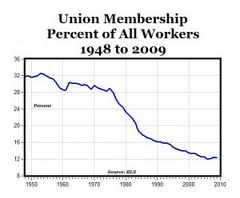
                                                            Just under 18% of Rhode Islanders are represented by labor unions; it was 26% in 1964, and 22.5% in 1984.  In other words, the trend is the same here as everywhere:  downward.

                                                            The national trend, since the passage of Taft-Hartley in 1947:

                                                            The breakdown by state, since 1964:


                                                            There are many reasons for this decline.  Economic change, the shift of American industry and population to the South and Southwest, the restrictive nature of our labor laws, McCarthyism and red-baiting, poor and sometimes corrupt union leadership.  Unions were also victims of their own success; by helping to create the post-war middle class, many of their white constituents (and their children) decamped for the suburbs, and resisted seeing the struggles of the black (and eventually, Latino) working class they left behind as similar to their own, rather than a threat.  In other words, the American original sin of race infected -- had long infected -- even its most transformational social movements and institutions.  Perhaps our individualistic and materialistic culture has also become indifferent -- even hostile -- to the sensibility of solidarity, upon which the labor movement depends.

                                                            All of these things have mattered, but the most important cause of labor's decline, ultimately, has been the political success of corporate resistance, particularly since the early 1970s (on this, read Elizabeth Fones-Wolf and Jefferson Cowie, as well as Jacob Hacker and Paul Pierson).  Many of my peers (and my students) seem to assume that unions are a thing of the past, and that the victories they won -- like the end of slavery and the enfranchisement of women -- are now written in stone, and we can move on.  In other words, progress gave rise to unions, and then tossed them on the scrap heap of history (with the American Anti-Slavery Society, The Women's Party, the NAACP, and affirmative action) when they had fulfilled their role.  Events in Wisconsin (and, of course, the Occupy movement) may have finally awoken at least some of these folks to the possibility that if the ship of history has moved in this direction, it may be because someone is steering it there.

                                                            As a labor historian and former organizer, I also had a hard time getting my head around the idea that unions could actually be too powerful -- both because I can't imagine that being the case anywhere in 21st America, and because I can't imagine that being a negative thing, on balance.  I would love to have to grapple with that problem, here and nationally.

                                                            Walter Reuther, vampire-killer...or life raft?

                                                            So why does the decline of labor matter, in Rhode Island and nationally?

                                                            Well for one, it is hard not to be struck by the apparent correlation between the decline of union power, and the emergence of increasing inequality, economic insecurity, and wage stagnation for large portions of our population since the early 1970s.  From 1940 until the early 70s, the economic benefits of the productivity of the American economy were widely shared, leading to what economists have called 'the Great Convergence':  a shrinking of income inequality, combined with a strong and steady increase in the standard of living for the vast majority of the population.

                                                            But since then?


                                                            So where did all that money go?  Did it go to those wealth-sucking and budget-busting public employees that Scott Walker keeps going on about?  Did those tax-and-spend liberals devour all of it, so they could rain manna on their special interest constituencies?

                                                            Um, no.


                                                            Is it any wonder why vampire stories seem to have captured the cultural zeitgeist?

                                                            Wednesday, March 28, 2012

                                                            Is freedom really the issue in the Court's health care deliberations?

                                                            There is much more at stake in the Court's deliberations about the Affordable Care Act (ACA) than just this one bill. Some of the conservatives on the court would like to eliminate the expansive post-New Deal constitutional interpretation of the Commerce Clause, depriving the American people of the ability to address our common concerns in the way that all modern states do.

                                                            Does anyone honestly think that our freedom is more threatened by the ACA, than by the class-based rationing of basic health that will persist and expand in its absence?  What good is a freedom if there is no practical political technology that allows us equal access and the ability to exercise it?

                                                            Saturday, July 02, 2011

                                                            Cynicism, government, and subsidiarity


                                                            I cross-posted my piece on "Penny-wise and (Rand) Paul Foolish" on RIFuture.org yesterday.  The article below is a response to a commenter, who raised 2 points:
                                                            1.  Given the functioning of our public school system in recent decades, isn't my call for universal public pre-k overly optimistic, if not misinformed
                                                            2.  Rather than giving the IRS more authority -- since government does very few things well anyway -- should we just simplify the tax code? 
                                                            First, your point and mine with regard to the IRS aren't incompatible.  I'm all for simplifying the federal tax code.  It would cut down on abuse, and make enforcement easier.  Unfortunately, pols from across the political spectrum share the responsibility for having made the code so immensely complicated.  


                                                            Suzanne Mettler has a really important article in the latest issue of the Washington Monthly, in which she points out how tax expenditures and credits have essentially substituted for other forms of policy in recent decades.  My sense is that my fellow liberals are particularly guilty of this.  Unable to win the argument politically for a stronger and more expensive social safety net, or more authoritative regulations, tweaking the tax code seems to have become the apparently 'cost-free' way to make policy that liberals, moderates and many conservatives can agree on.  The problem, of course, is that writing the tax code with a dry erase marker means that someone else can re-write it...and when regs and codes get re-written, it is usually to the benefit of the privileged, outside of the light of public scrutiny.  The tax code is also an awkward and often inefficient tool for making social policy.
                                                             If we simplify -- and lord knows there are lots of ways to do that -- we can return the tax code to its primary purpose, which is of course to raise revenue.  I don't think all purposeful taxes are bad, far from it (I like the estate tax, and a carbon tax, and many others), but simpler would be better...as long as the system retains its progressive nature.  Right now, in terms of actual taxes paid, the American tax system (federal income, payroll, state, property) has lost most of its progressivity.  This is in part responsible for the massive expansion of inequality in this country in recent decades.
                                                            Second, your cynicism about government (can we pull off public pre-k; govt spending is nearly always wasteful) was precisely what I was aiming at in my post.  I see the same sentiment from all sides of the political spectrum.  I think that kind of cynicism about government is factually inaccurate, politically dangerous, and -- to be frank -- intellectually lazy.  I don't want to get into public education too much here, but one gets a little tired of the constant laments about the poor quality of the system from liberals and conservatives alike.  The fact of the matter is that the system works well for the vast majority of American school kids.  Where it falls short is in the education of the poor, and students of color.  While obviously some of that is connected to flaws in how we've structured school governance and finance (particularly in cities), as much if not more of it stems from the fact that we have a lot of child poverty in this country, and that we geographically concentrate so much of that poverty, particularly among people of color.  The failures of our public schools are failures of political will, more than they are failures of government as such (in other words, the 'public' part of 'public schools' isn't the issue).
                                                            So much of our public discourse has shifted in this direction in recent decades.  One consequence, which I lament even if you don't, is the virtual elimination of liberalism from mainstream political reality.  Another, which we are discovering right now on the debt ceiling, the deficit, the Great Recession, global warming, etc, is that we have rendered ourselves incapable as a nation of grappling with the biggest issues we face.  Other than Obama's health care bill, I find it hard to name any large-scale issue that our federal government has fully addressed since the early 70s environmental legislation.  My point, in the end, was that people across the political spectrum should be able to agree on a basic point (one finds this consensus in other wealthy countries):  that government has certain basic responsibilities, and that progressive forms of taxation are the best way to pay for them. 
                                                            Personally, I'm one of those rare left-liberals who finds the Catholic notion of 'subsidiarity' convincing.  American conservatives often argue that subsidiarity is simply a call for smaller government, and more room for the marketplace.  I'm no theologian (I'm not even Catholic), but I think this is a misunderstanding.  It does insist that as many decisions as possible should be left to the local level, where citizens are more likely to be directly engaged.  But at its core is an ethical imperative for communal, institutional or governmental action to create the social conditions necessary to the full development of the individual, family and community.  That means larger and more interventionist government where its appropriate, with a preference for decentralization...but only if that best serves the ethical imperative. 
                                                            If American conservatives want to criticize poor government, fine -- I'm with them on that.  But when it slides into criticism of governance itself, they lose me. 

                                                            Wednesday, June 29, 2011

                                                            Penny-wise, (Rand) Paul foolish -- or, why government often matters

                                                            It appears, at times, that American conservatives seem to even deny the possibility that government spending or regulation might actually save money -- either save the government money (a secondary consideration) or save the country money (presumably, the primary goal).  As I noted yesterday, there is now ample empirical evidence that environmental regulation (along with Medicaid) has decreased infant mortality; for decades now, scholars have argued that the 1944 G.I. Bill more than paid for itself as well.  Spending large sums of public money on high quality universal pre-school would reduce all sorts of other economic and social costs, both for the government and for the nation as a whole.  There are, of course, far too many other examples to recount here.

                                                            It should be said that cost-benefit analysis should not be the only rubric for measuring whether a government program, tax or regulation is worthwhile.  Take the estate tax, for example:  as Andrew Carnegie and Theodore Roosevelt argued early in the 20th century, the goal was in large part to break up concentrated wealth.  "The man of great wealth owes a particular obligation to the State because he derives special advantages from the mere existence of government," Roosevelt told Congress in 1906.  "The prime object should be to put a constantly increasing burden on the inheritance of those swollen fortunes which it is certainly of no benefit to this country to perpetuate."  The revenue it generated was a side benefit.  It is important for liberals to continue to stress that in most cases, most of the time, government works.  Post-New Deal liberalism was founded on 2 core ideas, both of which made sense to many Americans who came of age in the 30s, 40s and 50s:

                                                            1)  that disaster (economic, natural, medical) can strike any of us at any time, so we should be willing to share or pool risks; and
                                                             2) that we can and should collectively build and maintain common institutions and goods through the instrument of government.  Like American liberalism more generally, these two assumptions are as conservative as they are liberal -- this explains much of their appeal, in fact.

                                                            While one can translate those two core ideas into a purely economic calculus, I think this misunderstands them.  More to the point, it ignores the fact that there are other justifications for government action that are valid as well:  justice, for example.  Public or common goods must be created, protected and enhanced, since private action is unlikely to do so.  And this must be done even if we cannot sufficiently calculate or determine a monetary benefit.  There is a danger, a slippery slope for liberals (and the country) in arguing that only a 'return on investment' constitutes a valid rationale for state action.  For one, if a healthy return cannot be demonstrated, it feeds public resentment of taxation (see my taxaphobia post of a few days ago).

                                                            One result has been a surprisingly bi-partisan denigration (and de-funding) of the IRS over the past decade or so.  Little money has been or can be saved by trimming the IRS budget.  Indeed, one can convincingly argue that a big chunk of the present deficit could be erased simply by beefing up IRS capacity, so it can go after individuals and corporations that aren't paying their fair share.   The Government Accounting Office (GAO) recently estimated that approximately $330 billion in federal taxes had never been paid as of the end of fiscal year 2010.  A good chunk of the tax evaders are individuals with "substantial personal assets" including multi-million-dollar homes and luxury cars, the GAO reported.   For every dollar the IRS spends on audits, liens, and property seizures, the government brings in more than $10.  If we spend less on IRS enforcement, as Republicans demand (and to which Democrats too often acquiesce), it costs us.  Obviously it costs our government revenue, but there is another cost, too:  it slowly undermines public faith in the rule of law.  Surely this is an odd position for conservatives to take.  A society that cannot tax itself, and that undermines popular belief in the effectiveness of government, will generate a politics that slowly devours itself -- like an autoimmune disease.  We have certainly reached this point now, haven't we?

                                                            The common assumption that any dollar spent by government is inherently wasteful simply flies in the face of evidence, historical and contemporary.

                                                            In keeping with this theme, Steven Benen of Washington Monthly usefully points us toward an exchange between Sen. Bernie Sanders (I-VT), Sen. Al Franken (D-MN) and Sen. Rand Paul (R-KY) earlier this week, during a subcommittee hearing on funding the existing Older Americans Act.  Sanders made the point that spending $2 billion to prevent hunger among the elderly should be considered an investment, because it would ultimately save money (for the feds, and overall) on health care and nursing home costs.

                                                            Paul was incredulous that any federal program or regulation could be considered an investment.  "It's curious that only in Washington can you spend $2 billion and claim that you're saving money.  The idea or notion that spending money in Washington is somehow saving money really flies past most of the taxpayers."

                                                            The brief exchange is worth watching:

                                                            Friday, June 24, 2011

                                                            Conservatism, taxes and the defense of inequality

                                                            As Ezra Klein points out today, GOP leadership in Congress continues to stubbornly resist tax increases as a legitimate part of any bi-partisan deficit reduction package.  "President Obama needs to decide between his goal of raising taxes, or a bipartisan plan to address our deficit," said Senators McConnell and Kyl in a joint statement. 


                                                            One wonder where all of this will wind up.  The GOP appears to be wrong on both the politics and policy. Polls consistently show that most Americans accept that any deficit reduction package will have to include cuts and revenue increases -- with the overwhelmingly majority of them favoring increased taxes on the wealthy.  It is hard not to think that the GOP's baseline position is defined not by fiscal austerity or a philosophical commitment to small government, but by opposition to wealth redistribution and the desire to protect the economics interests of the privileged.  


                                                            In a must read article in Democracy, Jonathan Chait dug deeply into the 'taxophobia' that seems to uniquely define American conservatism in this historical moment.  The conservative movement's 
                                                            embrace of taxophobia is probably the most important development in American political life over the last three decades. It is the one quality that most distinguishes American conservative elites from conservative elites in other countries. They’re more likely to question climate science, more sanguine about people dying for lack of health insurance, and less xenophobic (which is rather nice). But above all—far above all—they hate taxes.
                                                            Political science research indicates that this taxophobia has been the prime driver of the growing partisanship on economic and redistribution issues among our political elites.  More profoundly, Chait argues, conservative taxophobia has redefined the terms of the political debate.  Democrats are the new fiscal conservatives, while the old fiscal (Keynesian) liberalism stands at the fringes of our economic discourse.  Despite three decades of evidence contradicting supply-side economics, its hold on the Republican Party has only strengthened.


                                                            Chait again:
                                                            The Republican Party inhabits an otherworldly new realm that even the staunchest right-wingers of a generation before could scarcely have imagined. As the two parties trade power back and forth, the ideological basis for economic policy ping-pongs between the old right and a loopy kind of far-right. Periods of Republican governance have grown increasingly disastrous, while periods of Democratic governance are largely consumed with staving off fiscal collapse.
                                                            Clearly taxophobia in the GOP persists despite the empirical evidence.  Outside the rarified air of the Republican leadership, there is little questioning of the role that tax cuts have played in getting us to this point.  As Lori Montgomery wrote when analyzing the component parts of our shift from surpluses to deficits, "the biggest culprit, by far, has been an erosion of tax revenue triggered largely by two recessions and multiple rounds of tax cuts. Together, the economy and the tax bills enacted under former president George W. Bush, and to a lesser extent by President Obama, wiped out $6.3 trillion in anticipated revenue."  Simply letting the Bush tax cuts expire on schedule (or paying for any portions that policymakers decide to extend) would stabilize the debt-to-GDP ratio for the next decade.  The Center for Budget and Policy Priorities provides us with this useful chart:

                                                             Tax Cuts, Wars Account for Nearly Half of Public Debt by 2019


                                                            Clearly, there is a political and ideological commitment to taxophobia in today's GOP, quite distinct from whether there is any evidence for its effectiveness as policy -- indeed, policy may very be irrelevant.  It is hard for anyone with even a basic knowledge of the economic history of the US in the past 3 decades to maintain -- as the GOP does today -- that tax cuts will both generate revenue and put a cap on government expenditures.  So why the taxophobia?  Other than in the early 80s, perhaps, one cannot argue that pure vote pandering is the cause, particularly because the sorts of tax cuts the Republicans have consistently favored (and enacted) have been heavily skewed toward the top of the income ladder. 

                                                            Thursday, August 02, 2007

                                                            Two Cheers for Liberalism (August 2007)

                                                            The article below was originally posted on The Public Humanist, a blog published by Mass Humanities. I am an infrequent writer on the blog. Enjoy!

                                                            So what is American liberalism, and how (if at all) has it changed since the 60’s? Is it truly as irrelevant to our times as the "re-branding" of Senator Clinton and others would seem to indicate? In its broadest meaning, the classical political liberalism that emerged in the 17th and 18th centuries – based upon constitutional government and individual rights – is an intellectual heritage shared by liberals and conservatives alike. It was in the late 19th and early 20th centuries, heralding the emergence of corporations and the rapid expansion of wage labor, when today’s liberals and conservatives began to part ways.

                                                            The essential difference revolved around their approach to what was called the “social question”: what is to be done about the poverty and insecurity generated by the new economic and social order? Or, to put it somewhat differently, is the unequal distribution of economic power a threat to liberal government? Future conservatives thought freedom was best protected by property rights, contract, and a limited government, and generally denied the existence and relevance of the whole idea of “economic power.” Pushed by social movements as well as theological developments (the Social Gospel for Protestants, and the papal encyclical Rerum Novarum for Catholics), future liberals began to articulate a broader definition of effective freedom, a more robust conception of power, a moral need for social solidarity, and a new role for government.

                                                            Modern American liberalism came into its own under Franklin Delano Roosevelt in the thirties and forties. The commonly told political story is that liberalism triumphed in 1936, and in the post-war era shaped a politically dominant “consensus” that wasn’t shaken until the late sixties, liberalism’s “high water mark.” Liberals were never really as dominant as people think; conservatives had limited liberals from the very beginning of what’s understood as the liberal/conservative dichotomy, not suddenly in the 60s. The New Deal coalition patched together by Franklin Roosevelt in 1936 was limited from its inception by the political and racial conservatism of the apartheid South, as well as by a conservative business class that became increasingly active politically in the Cold War era. The ability of liberalism to grapple with the two central dilemmas of 20th century American life – the social question, and race – was severely circumscribed by steady opposition from the very beginning. While one can certainly criticize the limits of liberalism’s reach on these two issues (particularly the latter), one must also properly understand the limits of its grasp.

                                                            Pushed by the reborn labor movement, Franklin Roosevelt provided American liberalism’s answer to the social question. Liberalism borrowed its moral sensibilities from the seemingly “unliberal” notions of solidarity and interdependence, but deployed them in the service of liberalism’s essential concern: freedom. Because of the Great Depression, Roosevelt argued, “we have been compelled to learn how interdependent upon each other are all groups and sections of the population of America.” This interdependence convinced Roosevelt that “true individual freedom cannot exist without economic security and independence,” because “necessitous men are not free men.” In an economy dominated by “the often intangible forces of giant industry,” Roosevelt argued in 1938, a person’s “individual strength and wits” cannot guarantee security or freedom any more. More than anything else, Roosevelt argued, Americans want “work, with all the moral and spiritual values that go with it; and with work, a reasonable measure of security” for them and their families. Modern freedom required an opportunity to make a decent living – not just enough to live by, but also “something to live for,” in Roosevelt’s words. American liberalism was a public philosophy of both individual freedoms and social solidarity. Not only were these things not mutually exclusive; they depended upon one another.

                                                            The imbalance of economic power in American society, Roosevelt insisted, had led a growing number of citizens to believe that liberty was no longer real. Government must do more than just protect the right to vote; it must also “protect the citizen in his right to work and his right to live?freedom is no half-and-half affair.” This would not deny individual responsibility; rather, it would define it in a way that seemed reasonable and fair to people in the real world. Freedom from desperate conditions – security – was thus an essential supplement to political freedom. This was an old idea, deeply rooted in the nation’s founding. It was based on the old republican notion of freedom as "self-government," as articulated by Paine, Jefferson, and many others. The needy lack the independence and security to be self-governing, and thus they are not free citizens.

                                                            Roosevelt’s answer to the social question became the centerpiece of a powerful public philosophy that dominated American liberalism into the 1960s. Indeed, throughout the developed West (and Japan) in the decades after World War II, the notion of a “social contract” that democratized wealth and opportunity became widespread, contributing to economic expansion and the growth of a stable and prosperous middle-class. Welfare states were established, embodying a generation’s hopes for universal economic security and protection from the worst of life’s hazards. In the US the G.I. Bill typified this use of Hamiltonian means to Jeffersonian ends, helping to spark a massive expansion of home ownership and college attendance. Economic, tax and social policy, investments in infrastructure (highways, education, and especially housing), and the growth in collective bargaining, were primary factors that helped to broadly distribute the nation’s unprecedented prosperity. This, in turn, provided widespread access to property ownership, education, and mass consumption for millions of white Americans.

                                                            Today, liberalism no longer concerns itself with the "social question." Indeed, it has not done so for decades now. It is this, as much as anything, that lends credence to many of the criticisms directed at liberals from all sides. It isn’t that liberalism lacks any kind of moral core, as conservatives assert; nor is it overly individualistic and rights-based, as more friendly critics contend. For much of the 20th century American liberalism was a public philosophy grounded in social solidarity and a moral (and even theological) critique of inequalities of power.

                                                            There are many reasons why the social question has dropped out of American political discourse. One could argue, for example, that the institutional and geographic underpinnings of social solidarity have greatly eroded in recent decades, as white Americans decamped to the suburbs, our older cities imploded under the pressure of economic change and racialized neglect, and unions lost their radical edge and then their membership. Only a militarized patriotism seems capable of successfully evoking solidarity today. One could argue that the inability (and frequent unwillingness) of liberals to overcome white resistance to a solidarity that fully included black Americans generated a chastening backlash against all active government. The growing political power of corporations has also played a role, joining with conservatives to fetishize “free” markets and deny that government has any meaningful role to play in shaping the material preconditions of effective freedom.

                                                            Historian Robert Dallek cites a comment someone made to Eleanor Roosevelt shortly after her husband’s death: “I miss the way your husband used to speak to me about my government.” Government, even metaphorically, is not the enemy; it is, after all, “our” government. When Senator Clinton runs away from liberalism, she runs away from this bit of hard-won political wisdom. A politics that dissolves the personal connection between citizen and government in favor of an adversarial one threatens to undermine our capacity for discussing and meeting common needs. Like an autoimmune disease, an unreflective hostility to government threatens to turn the protective forces of the body politic against the body itself. As Franklin Roosevelt eloquently put it in 1936, “better the occasional faults of a Government that lives in a spirit of charity than the consistent omissions of a Government frozen in the ice of its own indifference.”