You know, part of my joy today is about the Supreme Court's decision on the Affordable Care Act -- but I think its deeper than that.
Its rooted in my sense that the legitimacy of a core American institution (the Court) wavered, even shook, but ultimately remained in place.
I remember the acid in my stomach after the Bush v. Gore decision, and anticipated having the same feeling this morning. The nihilism that American conservatism seems to have adopted seems bent on devouring standards, institutions and processes that have served this country well for a very long time -- like some sort of civic auto-immune disease.
As James Fallows recently wrote, "liberal democracies depend on rules, but also on norms -- on the assumption that you'll go so far, but no further, to advance your political ends. The norms imply some loyalty to the system as a whole that outweighs your immediate partisan interests."
It was out of such loyalty that Gore stepped aside after the Court stopped the vote count in 2000, as much as many of us wanted him to fight. It was in violation of that loyalty that the Bush campaign sought to stop the vote count, and in violation of that loyalty that the Supreme Court's narrow majority upheld Bush's strategy.
It was in support of that loyalty that Chief Justice John Roberts, however reluctantly, ruled today. Perhaps there still are a few true conservatives left among the bomb-throwing crazies, who would undo in the name of patriotism all that makes that patriotism morally justifiable.
Sir Thomas More, as quoted in "A Man for All Seasons":
"And when the last law was down, and the Devil turned 'round on you, where would you hide, ...the laws all being flat? This country is planted thick with laws, from coast to coast, Man's laws, not God's! And if you cut them down..., do you really think you could stand upright in the winds that would blow then? Yes, I'd give the Devil benefit of law, for my own safety's sake!"
Thursday, June 28, 2012


America joins the ranks of civilized nations!
Victory! I'd like to take this time to welcome my country to the 20th century, and offer a brief shout out to Franklin Roosevelt, Harry Truman, and every great American who has fought for universal healthcare as a human right.
And thanks, most important, to President Obama -- who saw this once-in-a-lifetime opportunity, and grabbed it!
And thanks, most important, to President Obama -- who saw this once-in-a-lifetime opportunity, and grabbed it!
Monday, June 25, 2012
A love song for Anthony Kennedy
I just met you, and this is crazy, but here's ObamaCare -- uphold it baby!
[A revision: Kennedy you two-timing so and so, this is for John Roberts instead.]
[A revision: Kennedy you two-timing so and so, this is for John Roberts instead.]
Twiddling my thumbs while waiting for modern liberalism to die
Bloomburg news surveyed 21 top constitutional law professors about the impending Supreme Court decision on the Affordable Care Act. 19 of them said that if the court follows legal precedent, it (the individual mandate) will be upheld.
“The precedent makes this a very easy case,” said Christina Whitman, a University of Michigan law professor. “But the oral argument indicated that the more conservative justices are striving to find a way to strike down the mandate.”
Only 8 of the 21 legal scholars actually expect the mandate to be upheld, despite the clear direction of constitutional precedent.
What does this tell us about the conservative majority on the Court? And the old right-wing saw about liberal activist judges?
18 of the 21 agreed that if the individual mandate is overturned on a 5-4 vote, it will damage the credibility of the Court itself.
“When you take the fact of a high-profile, enormously controversial and politically salient case -- to have it decided by the narrowest majority with a party-line split looks very bad, it looks like the court is simply an arm of one political party,” University of Chicago Law Professor Dennis Hutchinson said in an interview.
However, I'm not going to despair yet, at 9:23am on Monday June 25th (an announcement could come as soon as 10am). Liberal constitutional lion Bruce Ackerman still believes that conservatives Roberts and Kennedy won't be able to pull the trigger: “I continue to find it extremely unlikely that Justices Roberts and Kennedy will support a 5-4 decision that has such an insubstantial basis in 75 years of Supreme Court case law."
Ackerman, alas, was the only respondent who said the court is very likely to uphold the insurance-coverage requirement -- the opinion that was held by most legal observers across the ideological spectrum, until oral arguments.
Stay tuned....
“The precedent makes this a very easy case,” said Christina Whitman, a University of Michigan law professor. “But the oral argument indicated that the more conservative justices are striving to find a way to strike down the mandate.”
Only 8 of the 21 legal scholars actually expect the mandate to be upheld, despite the clear direction of constitutional precedent.
What does this tell us about the conservative majority on the Court? And the old right-wing saw about liberal activist judges?
18 of the 21 agreed that if the individual mandate is overturned on a 5-4 vote, it will damage the credibility of the Court itself.
“When you take the fact of a high-profile, enormously controversial and politically salient case -- to have it decided by the narrowest majority with a party-line split looks very bad, it looks like the court is simply an arm of one political party,” University of Chicago Law Professor Dennis Hutchinson said in an interview.
However, I'm not going to despair yet, at 9:23am on Monday June 25th (an announcement could come as soon as 10am). Liberal constitutional lion Bruce Ackerman still believes that conservatives Roberts and Kennedy won't be able to pull the trigger: “I continue to find it extremely unlikely that Justices Roberts and Kennedy will support a 5-4 decision that has such an insubstantial basis in 75 years of Supreme Court case law."
Ackerman, alas, was the only respondent who said the court is very likely to uphold the insurance-coverage requirement -- the opinion that was held by most legal observers across the ideological spectrum, until oral arguments.
Stay tuned....
Tuesday, June 12, 2012
Race, generational politics, and the Democrats great opportunity
The whitening of the Republican Party, and the great white Boomer estate sale
In the June 7th 2012 online edition of the New York Times, columnist Charles Blow broke down the findings of the recent Pew Research Center American Values survey along racial lines.
Blow points to 3 important findings:
First, since 2000, while the percentage of GOP supporters that are white has remained steady (87%), the percentage of Democrats who are white has fallen from 64% to 55%. Interestingly, the racial breakdown of 'independents' has also changed -- from 79% white in 2000, to 67% white in 2012.Blow's conclusion: "if current trends persist, in a few years the Democratic Party will be a majority minority party."
Second, whites, blacks and Latinos often have very different views about poverty, opportunity and the role of government.Blow's conclusion: because the Democrats are increasingly diverse racially (blacks, Latinos), while the Republicans are not, these racially divergent views are going to profoundly affect the national debate in this election year.
Third, swing voters (those who are undecided, who lean towards a candidate, or who say that they could change their mind) are overwhelmingly and disproportionately white (nearly 3/4). Pew found that these voters lean more towards Obama on issues like civil liberties and the role of labor unions, but are closer to Romney on the social safety net, immigration, and affirmative action.Blow's conclusion here is implied rather than stated, but the implication is pretty clear: Obama will lose if the focus of the 2012 campaign is on these 'racially charged issues.' The deeper implication is that the GOP would benefit from a campaign that is focused on these things.
I don't have any major quibbles with Blow's analysis, though some of the data he cites really pushes one towards a more radical conclusion, one which he didn't hint at, even obliquely:
As the Democratic Party slowly begins to reflect the demographic changes underway in the country (in its constituencies, if not yet in its positions), the Republican Party is increasingly becoming the Defense of White Privilege Party, and its short-term electoral interests are leading it even further in that direction.Of course, behind the curtain an awful lot of what Republican policymakers actually do has much more to do with the protection of capital (particularly financial capital) than the protection of white privilege per se -- but the nudges, winks and dog whistles, particularly for the Tea Party folks, are often racially inflected.
And if the GOP's defense of the current structure of American wealth (and its defunding of those institutions which might offer wider access to it or challenge it) isn't at the same time a defense of a certain kind of white privilege, what is it? If those who have climbed the ladder are overwhelmingly white, and you pull the ladder up behind you, what (who) have you defended? There is no reason to think that because the Party houses within it a supposedly cosmopolitan financial elite and an aging coalition of economically and racially insecure whites, that these differences will somehow temper the racial nature of its appeal. For most of the history of our country, corporate and financial interests have been entirely comfortable and compatible with a white supremacist politics.
Almost every major policy position the Republican Party now takes will work to the benefit of white voters, and to the detriment of citizens of color. Attacks on public employee unions and Paul Ryan's call for massive cuts in non-defense spending has (and will) disproportionately affect black and Hispanic workers. Likewise with pay freezes for public workers, and pension and health insurance cutbacks. All of this constitutes an assault on a black middle class that has already seen billions of dollars of its wealth stripped away by sub-prime lending and the collapse of the housing market -- with these things, in turn, enabled by financial deregulation and the refusal to meaningfully address housing discrimination and residential segregation.
Democrats may try to take some comfort in the belief the GOP's coalition of cosmopolitan financial capital and economically and racially insecure whites will inevitably blow apart, as the latter gradually begins to see what is truly 'the matter with Kansas.' This comfort, however, is misplaced -- at least in the short-term. What holds this coalition together at the moment is a unifying hostility to the nature and reach of the modern American state. Financial elites largely maintain the same position on this issue that they have since they wormed their way into the Republican Party in the 1860s and 1870s: government should be small and weak, except when it aids in the accumulation of capital, and protects it against internal and external competition. Insecure whites, particularly those who increasingly affiliate themselves with the Tea Party, believe that the young, the lazy and the dark are parasitically living off of the hard work of whites -- aided by President Obama.
Of course, the GOP hostility to government (and labor) as a counterweight to concentrated economic power and the inherent vicissitudes of life in a market society directly challenges the civil and social rights that have enabled whatever progress toward racial justice we've achieved in the past half-century. A government with such a diminished reach inevitably comforts the comfortable, and afflicts the afflicted. That it will afflict a large number of white Americans too -- particularly the young -- is clear. The future of the country will depend upon whether these white Americans will answer the GOP's racial siren song, or make common cause with their fellow citizens who represent the nation's demographic future.
While at first blush all of this seems to be about fiscal conservatism, it really isn't. You can't balance budgets or grow the economy (or govern effectively and justly) with massive tax cuts, and greatly diminished public investments in infrastructure, institutions, and people. Not only is the GOP no longer the party of Teddy Roosevelt; it isn't even the party of its Whiggish predecessor Henry Clay.
But more revealing is the nature of the rhetoric on the Right: we have witnessed the revival of the racially-tinged language of "government dependency," courtesy of the Tea Party.
Blow notes that a remarkable 90% (!) of Romney's supporters are white (87% of Republicans are), and that white independents also move into the Romney camp when the focus is on social programs and immigration, which he describes as 'racially charged issues.'
There is no inherent reason why the discussion of social programs during the worst economic downturn since the Great Depression should be 'racial' in nature, particularly since the vast majority of poor Americans are white, and whites are by far the greatest beneficiaries of the welfare state. Immigration isn't inherently a 'racially charged' issue either; it is a demographic issue, perhaps, but the push and pull factors that shape the flow of immigration are largely economic.
The deeper question is this: what makes the social safety net and immigration 'racially charged' issues? Perhaps this is obvious, but it needs to be stated: it is white Americans who make these subjects 'racial.' Not blacks, not Latinos, not liberals, and not Democrats. Whites.
It is well known that by the middle of this century, 'whites' (as Americans have come to define them since World War II) will no longer constitute a majority of the population of the United States. In many places, this has either already happened, or soon will. On the eve of the financial crash, the U.S. Census Bureau announced that non-Hispanic whites would become a minority in the country in 2042, eight years earlier than had previously been estimated.
The collision of the Great Recession with demographic change has lent our already-polarized national politics a discomforting flavor of racial apocalypse, diverting many Americans -- and most of the Republican Party -- away from the inequalities that truly matter, and toward a paranoid defense of the favored racial quarter. We can see this in our daily lives, as American metropolitan areas re-segregate by race, while economic segregation metastasizes across the national landscape. We can see it in the racialized rhetoric of the Tea Party. And we can see it in the 'pull-up-the-ladder-of-opportunity' policies that the GOP increasingly recommends.
White Americans, of course, aren't monolithic. The Pew Survey makes clear that while a lot of whites seem to be hunkering down in the Republicans' racial redoubt (particularly older whites), those who continue to define themselves as Democrats increasingly share the views of most blacks and Latinos not only on economics, opportunity and the role of government, but also on the issues of immigration, affirmative action and social programs. The Survey indicates that this is particularly true for younger white voters.
The percentage of Republicans calling for "tighter immigration controls" has ticked slightly upward over the past twenty year, from 78% to 84%. There has, however, been a decided downward shift in opinions among Democrats, reflecting both demographic reality and a growing recognition of that reality by their white constituents, regardless of ideology or education. In 1992 there was basically no partisan gap on the issue; today, only 58% of Democrats think we need a more restrictive immigration policy, down from 74% in 1992. While independent voters are more favorably disposed toward tighter controls than Democrats are, the trend is largely downward -- reinforcing my point above, about the increasingly racialized GOP.
From the Survey:

There also seems to be an age correlation. While those between 18-29 and 30-49 are (for lack of a better term) 'pro' immigrant, older voters are not.
According to the Survey, Tea Party Republicans and Tea Party-leaning independents both seem to be more likely to be hostile to immigrants and skeptical of the persistence of racial discrimination than do Republicans more generally.
In other words, the Tea Party is a force for the continuing racialization of the GOP, as much as its most prominent advocates wish to deny it.
The GOP has effectively become the anti-immigrant party, as Thomas Edsall noted recently. Its constituents will not support candidates perceived as 'pro-immigrant,' as John McCain discovered in 2010. And within the larger context of economic insecurity -- when employment appears to be a zero-sum game -- immigration has also become an effective wedge issue for the Republicans. In 2010 and again this year, they are using it to appeal to economically stressed moderate white Democrats, who fear that immigrants are siphoning off jobs, tax dollars and public benefits, and that all of this has been enabled by the self-evidently 'foreign' Barack Obama. This of course ignores stacks of research indicating that immigrants are vital to the economic health of the country, and to the long-term viability of the very entitlement programs the Republicans say they are depleting. Indeed, the greatest threat to Social Security and Medicare is posed by the very candidates Tea Party voters support.
The Republican House vote margin among whites in 2010 (62% to 38%) was higher than in any House election since 1968, when exit polling first began. The GOP is shoving all of its white chips to the center of the table.
For Democrats, there is an optimistic scenario that can be drawn from this. There is also a dangerous -- even catastrophic -- one that can also be drawn. The damage inflicted by the latter would extend far beyond partisan imbalances, and do permanent harm to our democracy.
The more positive one, to be blunt, is that the combination of demographic change and the GOPs over-reaction to the demands of financial capital and the coming death-rattle of white Boomer privilege makes the electoral future of the Democratic Party (or some new party that emerges from it) very bright indeed.
Assuming there is anything left to inherit, once the White Baby Boomer Estate Sale has concluded.
What's the negative scenario? That in their effort to 'take their country back' and 'free up' capital to finance that effort, white Republicans will pull the entire structure down around them, diminishing their own future and everyone else's.
Let's start with the scary stuff first, so we can finish on a high note.
Tuesday, June 05, 2012
Solidarity, For Now? Liberalism and the Many Costs of Labor's Decline
Great piece today by Providence's own Joe Nocera, on what the decline of organized labor has done to the American Dream -- and a good day for it, too, as Scott Walker's revolutionary (non-union) train chugs into the Madison Station.
When I moved to RI in 2003 from Washington, I was rather stunned to hear many of my liberal friends repeat the media meme that organized labor was too powerful in the Ocean State [note: I will use the term 'liberal' rather than 'progressive,' because in my experience people on the left my age and younger tend to substitute the latter for the former, without knowing the meaning of either].
My surprise stemmed from two sources: the extent to which liberals of my generation (I'm 45) underestimate the vital importance of unions for the enactment and preservation of liberal measures and attitudes, and the extent to which these same liberals had completely misread the situation in their own state.
On the latter, read Scott McKay's brilliant take-down of the 'union rules RI' meme on NPR the other day. As he notes, would the tax equity bill have gone down to defeat if unions truly ruled the roost?
Just under 18% of Rhode Islanders are represented by labor unions; it was 26% in 1964, and 22.5% in 1984. In other words, the trend is the same here as everywhere: downward.
The national trend, since the passage of Taft-Hartley in 1947:
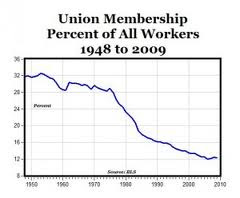

There are many reasons for this decline. Economic change, the shift of American industry and population to the South and Southwest, the restrictive nature of our labor laws, McCarthyism and red-baiting, poor and sometimes corrupt union leadership. Unions were also victims of their own success; by helping to create the post-war middle class, many of their white constituents (and their children) decamped for the suburbs, and resisted seeing the struggles of the black (and eventually, Latino) working class they left behind as similar to their own, rather than a threat. In other words, the American original sin of race infected -- had long infected -- even its most transformational social movements and institutions. Perhaps our individualistic and materialistic culture has also become indifferent -- even hostile -- to the sensibility of solidarity, upon which the labor movement depends.
All of these things have mattered, but the most important cause of labor's decline, ultimately, has been the political success of corporate resistance, particularly since the early 1970s (on this, read Elizabeth Fones-Wolf and Jefferson Cowie, as well as Jacob Hacker and Paul Pierson). Many of my peers (and my students) seem to assume that unions are a thing of the past, and that the victories they won -- like the end of slavery and the enfranchisement of women -- are now written in stone, and we can move on. In other words, progress gave rise to unions, and then tossed them on the scrap heap of history (with the American Anti-Slavery Society, The Women's Party, the NAACP, and affirmative action) when they had fulfilled their role. Events in Wisconsin (and, of course, the Occupy movement) may have finally awoken at least some of these folks to the possibility that if the ship of history has moved in this direction, it may be because someone is steering it there.
As a labor historian and former organizer, I also had a hard time getting my head around the idea that unions could actually be too powerful -- both because I can't imagine that being the case anywhere in 21st America, and because I can't imagine that being a negative thing, on balance. I would love to have to grapple with that problem, here and nationally.
Walter Reuther, vampire-killer...or life raft?
So why does the decline of labor matter, in Rhode Island and nationally?
Well for one, it is hard not to be struck by the apparent correlation between the decline of union power, and the emergence of increasing inequality, economic insecurity, and wage stagnation for large portions of our population since the early 1970s. From 1940 until the early 70s, the economic benefits of the productivity of the American economy were widely shared, leading to what economists have called 'the Great Convergence': a shrinking of income inequality, combined with a strong and steady increase in the standard of living for the vast majority of the population.
But since then?

So where did all that money go? Did it go to those wealth-sucking and budget-busting public employees that Scott Walker keeps going on about? Did those tax-and-spend liberals devour all of it, so they could rain manna on their special interest constituencies?
Um, no.


Is it any wonder why vampire stories seem to have captured the cultural zeitgeist?
When I moved to RI in 2003 from Washington, I was rather stunned to hear many of my liberal friends repeat the media meme that organized labor was too powerful in the Ocean State [note: I will use the term 'liberal' rather than 'progressive,' because in my experience people on the left my age and younger tend to substitute the latter for the former, without knowing the meaning of either].
My surprise stemmed from two sources: the extent to which liberals of my generation (I'm 45) underestimate the vital importance of unions for the enactment and preservation of liberal measures and attitudes, and the extent to which these same liberals had completely misread the situation in their own state.
On the latter, read Scott McKay's brilliant take-down of the 'union rules RI' meme on NPR the other day. As he notes, would the tax equity bill have gone down to defeat if unions truly ruled the roost?
Just under 18% of Rhode Islanders are represented by labor unions; it was 26% in 1964, and 22.5% in 1984. In other words, the trend is the same here as everywhere: downward.
The national trend, since the passage of Taft-Hartley in 1947:
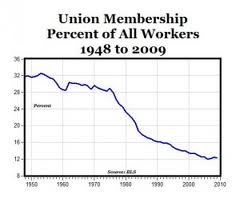
The breakdown by state, since 1964:

There are many reasons for this decline. Economic change, the shift of American industry and population to the South and Southwest, the restrictive nature of our labor laws, McCarthyism and red-baiting, poor and sometimes corrupt union leadership. Unions were also victims of their own success; by helping to create the post-war middle class, many of their white constituents (and their children) decamped for the suburbs, and resisted seeing the struggles of the black (and eventually, Latino) working class they left behind as similar to their own, rather than a threat. In other words, the American original sin of race infected -- had long infected -- even its most transformational social movements and institutions. Perhaps our individualistic and materialistic culture has also become indifferent -- even hostile -- to the sensibility of solidarity, upon which the labor movement depends.
All of these things have mattered, but the most important cause of labor's decline, ultimately, has been the political success of corporate resistance, particularly since the early 1970s (on this, read Elizabeth Fones-Wolf and Jefferson Cowie, as well as Jacob Hacker and Paul Pierson). Many of my peers (and my students) seem to assume that unions are a thing of the past, and that the victories they won -- like the end of slavery and the enfranchisement of women -- are now written in stone, and we can move on. In other words, progress gave rise to unions, and then tossed them on the scrap heap of history (with the American Anti-Slavery Society, The Women's Party, the NAACP, and affirmative action) when they had fulfilled their role. Events in Wisconsin (and, of course, the Occupy movement) may have finally awoken at least some of these folks to the possibility that if the ship of history has moved in this direction, it may be because someone is steering it there.
As a labor historian and former organizer, I also had a hard time getting my head around the idea that unions could actually be too powerful -- both because I can't imagine that being the case anywhere in 21st America, and because I can't imagine that being a negative thing, on balance. I would love to have to grapple with that problem, here and nationally.
Walter Reuther, vampire-killer...or life raft?
So why does the decline of labor matter, in Rhode Island and nationally?
Well for one, it is hard not to be struck by the apparent correlation between the decline of union power, and the emergence of increasing inequality, economic insecurity, and wage stagnation for large portions of our population since the early 1970s. From 1940 until the early 70s, the economic benefits of the productivity of the American economy were widely shared, leading to what economists have called 'the Great Convergence': a shrinking of income inequality, combined with a strong and steady increase in the standard of living for the vast majority of the population.
But since then?

So where did all that money go? Did it go to those wealth-sucking and budget-busting public employees that Scott Walker keeps going on about? Did those tax-and-spend liberals devour all of it, so they could rain manna on their special interest constituencies?
Um, no.


Is it any wonder why vampire stories seem to have captured the cultural zeitgeist?
Wednesday, May 09, 2012
Bibles and Circuses
So much for North Carolina as an 'enlightened' Southern state.
People: if you think that the institution of marriage is truly in danger in the United States, then please stop voting for politicians (and referenda) that ignore its greatest threat -- economic insecurity.
The ability of so many people to turn a religion based on love into one based on hate never ceases to amaze me. I don't want to just wax anti-religious here -- if it weren't for people of faith, North Carolina would still be a Jim Crow state -- but how many times do we have to see religion used to justify exclusion and hierarchy (slavery?), before we begin to question whether human flourishing is ultimately hindered by it?
People: if you think that the institution of marriage is truly in danger in the United States, then please stop voting for politicians (and referenda) that ignore its greatest threat -- economic insecurity.
The ability of so many people to turn a religion based on love into one based on hate never ceases to amaze me. I don't want to just wax anti-religious here -- if it weren't for people of faith, North Carolina would still be a Jim Crow state -- but how many times do we have to see religion used to justify exclusion and hierarchy (slavery?), before we begin to question whether human flourishing is ultimately hindered by it?
Wednesday, March 28, 2012
Is freedom really the issue in the Court's health care deliberations?
There is much more at stake in the Court's deliberations about the Affordable Care Act (ACA) than just this one bill. Some of the conservatives on the court would like to eliminate the expansive post-New Deal constitutional interpretation of the Commerce Clause, depriving the American people of the ability to address our common concerns in the way that all modern states do.
Does anyone honestly think that our freedom is more threatened by the ACA, than by the class-based rationing of basic health that will persist and expand in its absence? What good is a freedom if there is no practical political technology that allows us equal access and the ability to exercise it?
Does anyone honestly think that our freedom is more threatened by the ACA, than by the class-based rationing of basic health that will persist and expand in its absence? What good is a freedom if there is no practical political technology that allows us equal access and the ability to exercise it?
Friday, January 06, 2012
Will historicize for food, coffee
Which college majors have the highest unemployment rates, according to the Washington Post?
I'm proud to say that the 'Liberal Arts' (which includes my discipline, history) took the bronze medal - with an unemployment rate of 9.4%.
Since that is lower than the rate here in Rhode Island, I propose we tweak the Richard Florida thesis somewhat, and say f**k the creative class. Import historians! Think of the multiplier effects!
I can't think of any multiplier effects. Good thing I'm not an economist. If there were any justice at all, those people would have come in first (especially the 'freshwater' variety).
For the few 70s-era dead-enders who actually think history is a social science...those people came in 4th, with an 8.9% rate.
The worst rate? Architects. Is it any wonder that Shana and I don't have any money? And that the country is presently filled with whiny white Tea Partiers, contemplating the 'victimhood' of John Galt?
The major with the lowest unemployment rate? Its a tie between health and education. Illness and ignorance never go into recession, do they?
I'm proud to say that the 'Liberal Arts' (which includes my discipline, history) took the bronze medal - with an unemployment rate of 9.4%.
Since that is lower than the rate here in Rhode Island, I propose we tweak the Richard Florida thesis somewhat, and say f**k the creative class. Import historians! Think of the multiplier effects!
I can't think of any multiplier effects. Good thing I'm not an economist. If there were any justice at all, those people would have come in first (especially the 'freshwater' variety).
For the few 70s-era dead-enders who actually think history is a social science...those people came in 4th, with an 8.9% rate.
The worst rate? Architects. Is it any wonder that Shana and I don't have any money? And that the country is presently filled with whiny white Tea Partiers, contemplating the 'victimhood' of John Galt?
The major with the lowest unemployment rate? Its a tie between health and education. Illness and ignorance never go into recession, do they?
Thursday, January 05, 2012
Social mobility: the decline of American exceptionalism
Very good overview of the issue of social mobility in the U.S. in the Times today, by the always thoughtful Jason DeParle.
For a graphic comparing social mobility in the U.S. and Denmark, go here (tried to reproduce it here, but couldn't make it fit).
The piece is quite balanced, and notes that while arguments can be made for the moral, political and economic irrelevancy of inequalities of income, data indicating a lack of social mobility constitute a much more consequential challenge for conservatives. DeParle makes it clear that while scholars do argue over the data and their interpretation, the vast preponderance of research on mobility shows us two things: that mobility in the U.S. is lower than most people think, and that other comparably wealthy countries are much more mobile than we are. He doesn't note -- but I will -- another relevant fact: Canada and most of Western Europe and Scandinavia not only have more mobility within and across generations. The consequences of not moving up -- or of falling -- aren't nearly as dire as they are in the U.S.
The only real justification for the extraordinary inequalities of wealth that exist in the US today, is that while resources aren't distributed equally, opportunities are. But this is clearly not true, and hasn't been for quite some time. It is my sense that, barring definitive action by government at all levels, we are only at the beginning of a massive collapse of the opportunity structure in the US.
The tragedy of this is that over the last decade we have come to a greater understanding of how inequality is reproduced across generations, particularly among the very young -- and because of this research, we also have a pretty good sense of what the most effective policy instruments might be. But inequality generates a politics designed to protect privilege (surely this is the irony of the 'Tea Party,' as Thomas Frank argues in his new book), making it almost impossible for us to truly grapple with all of this as a nation.
For a graphic comparing social mobility in the U.S. and Denmark, go here (tried to reproduce it here, but couldn't make it fit).
The piece is quite balanced, and notes that while arguments can be made for the moral, political and economic irrelevancy of inequalities of income, data indicating a lack of social mobility constitute a much more consequential challenge for conservatives. DeParle makes it clear that while scholars do argue over the data and their interpretation, the vast preponderance of research on mobility shows us two things: that mobility in the U.S. is lower than most people think, and that other comparably wealthy countries are much more mobile than we are. He doesn't note -- but I will -- another relevant fact: Canada and most of Western Europe and Scandinavia not only have more mobility within and across generations. The consequences of not moving up -- or of falling -- aren't nearly as dire as they are in the U.S.
The only real justification for the extraordinary inequalities of wealth that exist in the US today, is that while resources aren't distributed equally, opportunities are. But this is clearly not true, and hasn't been for quite some time. It is my sense that, barring definitive action by government at all levels, we are only at the beginning of a massive collapse of the opportunity structure in the US.
The tragedy of this is that over the last decade we have come to a greater understanding of how inequality is reproduced across generations, particularly among the very young -- and because of this research, we also have a pretty good sense of what the most effective policy instruments might be. But inequality generates a politics designed to protect privilege (surely this is the irony of the 'Tea Party,' as Thomas Frank argues in his new book), making it almost impossible for us to truly grapple with all of this as a nation.
Wednesday, January 04, 2012
The passing of Robert L. Carter, and school desegregation in the metropolitan North
I was saddened to hear of the death of Judge Robert L. Carter yesterday, at the age of 94. The passing of this great generation of civil rights reformers (Fred Shuttlesworth and Derrick Bell are gone too) was of course inevitable -- Dr. King would be in his 80s, if he were still with us. But studying their words and work, one is reminded of just how limited our visions of justice are these days.
I had the great privilege of spending a week with Carter a few years ago, as a participant in an NEH seminar on civil rights up at Harvard. He was sharp, passionate and inspiring, as he regaled us with story after story about his legal work with Thurgood Marshall and the NAACP Legal Defense Fund, and walked us through his informative memoir, "A Matter of Law." If I remember correctly, I was a bit combative in some of our exchanges. Carter insisted on the transformative potential of school desegregation cases in the urban North, which he constantly pushed from within the NAACP in the mid/late 60s. I argued that the real issue was metropolitan housing segregation, and that a focus on the cities alone would achieve nothing more than tokenism, resistance, and white flight. He countered by emphasizing, rightly, the value of setting legal precedents. This was, after all, how the Brown decision was achieved in 1954: a long, slow walk through the court system. It was particularly important to get the courts to focus on impact, not intent, in the application of constitutional doctrine to segregation in the North. Once that was achieved, things could open up in much more transformative ways.
As background for my home ownership book, I've been doing some research on civil rights, the law and housing policy from the mid-60s to the mid-70s, and I'm in a much better position now to make sense of what Carter was trying to tell me -- and of his legacy. During this all-too-brief period, there was a possibility (albeit a thin one) that the nation might finally confront the pattern of metropolitan inequality and segregation (by race and class) that had emerged in the wake of World War II. Real discussions of the necessity of 'opening up the suburbs' were taking place, not only within the civil rights and fair housing movements, but also within the Johnson administration, the courts, and even in the early days of Nixon's first term (George Romney, Secretary of HUD, characterized suburbia as a 'white noose' around the neck of urban America). Most parties to this discussion recognized that both access to employment and to quality public education hinged on whether American metropolitan areas could be restructured. In other words, the future of the American opportunity structure was at stake -- but time was of the essence. The nation was on the cusp of a massive expansion in suburban development (and of home ownership), but the shape which our social geography would take was still somewhat plastic. The intellectual, judicial and policy tools were there to trace direct connections between social geography and opportunity, and to expand civil rights jurisprudence beyond the limited individualistic ontology that had previously defined it.
And Robert L. Carter was right there, at the forefront. Unfortunately for all of us, this brief window of opportunity to unwind metropolitan inequality had slammed shut by the mid-70s. There were small victories and experiments at the local and state level, here and there; the Mount Laurel decision, by the New Jersey Supreme Court in 1975, for example. But my argument about the 'window' is mostly aimed at the federal level.
Nixon gets some of the blame, as much because of his racial demagoguery as his urban and housing policies. His Supreme Court appointments get a lot of it, too. The San Antonio Independent School District v. Rodriguez (1973) and Milliken v. Bradley (1974) decisions carved a direct path to the urban school crisis we presently confront. Despite occasional exceptions at the state level, federal courts also continued to limit the reach of constitutional claims against exclusionary zoning, rendering fair housing law a dead letter in much of the country. Suburban white America captured the lion's share of the responsibility, and retains it today. While the Republican Party has become the unapologetic champion of white suburban privilege (see this recent piece by Daniel Denvir, on urban issues in today's GOP), the Democrats refuse to see what even George Romney (let alone Robert L. Carter) saw 40 years ago: that racial and class segregation is a recipe for disaster for the country.
Thanks, Mr. Carter, and rest in peace. That window is still closed, sadly. But it is surely cracked. And that, as Leonard Cohen once wrote, is how the light gets in.
I had the great privilege of spending a week with Carter a few years ago, as a participant in an NEH seminar on civil rights up at Harvard. He was sharp, passionate and inspiring, as he regaled us with story after story about his legal work with Thurgood Marshall and the NAACP Legal Defense Fund, and walked us through his informative memoir, "A Matter of Law." If I remember correctly, I was a bit combative in some of our exchanges. Carter insisted on the transformative potential of school desegregation cases in the urban North, which he constantly pushed from within the NAACP in the mid/late 60s. I argued that the real issue was metropolitan housing segregation, and that a focus on the cities alone would achieve nothing more than tokenism, resistance, and white flight. He countered by emphasizing, rightly, the value of setting legal precedents. This was, after all, how the Brown decision was achieved in 1954: a long, slow walk through the court system. It was particularly important to get the courts to focus on impact, not intent, in the application of constitutional doctrine to segregation in the North. Once that was achieved, things could open up in much more transformative ways.
As background for my home ownership book, I've been doing some research on civil rights, the law and housing policy from the mid-60s to the mid-70s, and I'm in a much better position now to make sense of what Carter was trying to tell me -- and of his legacy. During this all-too-brief period, there was a possibility (albeit a thin one) that the nation might finally confront the pattern of metropolitan inequality and segregation (by race and class) that had emerged in the wake of World War II. Real discussions of the necessity of 'opening up the suburbs' were taking place, not only within the civil rights and fair housing movements, but also within the Johnson administration, the courts, and even in the early days of Nixon's first term (George Romney, Secretary of HUD, characterized suburbia as a 'white noose' around the neck of urban America). Most parties to this discussion recognized that both access to employment and to quality public education hinged on whether American metropolitan areas could be restructured. In other words, the future of the American opportunity structure was at stake -- but time was of the essence. The nation was on the cusp of a massive expansion in suburban development (and of home ownership), but the shape which our social geography would take was still somewhat plastic. The intellectual, judicial and policy tools were there to trace direct connections between social geography and opportunity, and to expand civil rights jurisprudence beyond the limited individualistic ontology that had previously defined it.
And Robert L. Carter was right there, at the forefront. Unfortunately for all of us, this brief window of opportunity to unwind metropolitan inequality had slammed shut by the mid-70s. There were small victories and experiments at the local and state level, here and there; the Mount Laurel decision, by the New Jersey Supreme Court in 1975, for example. But my argument about the 'window' is mostly aimed at the federal level.
Nixon gets some of the blame, as much because of his racial demagoguery as his urban and housing policies. His Supreme Court appointments get a lot of it, too. The San Antonio Independent School District v. Rodriguez (1973) and Milliken v. Bradley (1974) decisions carved a direct path to the urban school crisis we presently confront. Despite occasional exceptions at the state level, federal courts also continued to limit the reach of constitutional claims against exclusionary zoning, rendering fair housing law a dead letter in much of the country. Suburban white America captured the lion's share of the responsibility, and retains it today. While the Republican Party has become the unapologetic champion of white suburban privilege (see this recent piece by Daniel Denvir, on urban issues in today's GOP), the Democrats refuse to see what even George Romney (let alone Robert L. Carter) saw 40 years ago: that racial and class segregation is a recipe for disaster for the country.
Thanks, Mr. Carter, and rest in peace. That window is still closed, sadly. But it is surely cracked. And that, as Leonard Cohen once wrote, is how the light gets in.
Finland Finland Finland, the country where I quite want to teach
As it turns out, Monty Python was right: Finland isn't just a great place for snack lunch in the hall...
It really does have it all: social democracy, smoked fish, and a public school system that American reformers are beginning to notice. Too bad they are noticing the wrong thing.
As many of you know, Finland is all the rage in education reform circles these days, particularly among those who don't think that teacher unions and school governance are the primary problems facing American public schools. Finnish school children have done very well on international tests in recent years (far better than the middling U.S.), prompting a wave of visits to Scandinavia by American politicians and educators, and speaking tours by Finns here.
Most of the discussion has revolved around their model for the professionalization of teachers -- kind of like Denver's experiment on steroids -- and on their lack of emphasis on standardized high-stakes testing and rote learning. All teachers in Finland must earn masters' degrees from competitive graduate programs, are paid like professionals, and given responsibilities for curriculum and assessment that vastly exceed those of American teachers in the post-NCLB era.
The curriculum, meanwhile, de-emphasizes competition and tracking, and tends to be much more focused on creative play and vocational preparation than one generally finds in American schools (particularly urban ones). According to a recent article by Samuel Abrams in The New Republic, Finnish schools provide students with far more recess than their American counterparts -- 75 minutes a day at the elementary level, compared to an average of 27 minutes in the U.S. They also mandate lots of arts and crafts, and more learning by doing.
American school reformers seem to see what they want to see in the Finnish success story. Liberals (if I can use that word in this context) point to their investment in early childhood education and parental leave policies, as well as the teacher autonomy discussed above. Conservatives point to the ability of Finnish schools to get high achievement out of students despite large class sizes, and regardless of background. If they can do it, they argue, why can't our teachers? Of course, the 'blame-the-teachers' mantra is somewhat undermined by the fact that Finnish teachers are unionized at even higher levels than American teachers are, and also have tenure.
It is also undermined by the fact that levels of inequality and child poverty in the U.S. vastly exceed Finland's -- a critical point.
Anu Partanan, a Finnish journalist, published a thoughtful short piece in the Atlantic Monthly in late December 2011 on K-12 education in her country. The takeaway: most American observers have really missed (ignored) what's at the core of Finnish school reform -- equity.
Dissatisfied with the quality of Finnish public education at the end of the 1960s, in 1971 a government commission concluded that economic modernization could only take place if schools were improved. According to Abrams, Finland committed to reducing class size, boosting teacher pay, and requiring much more rigorous training for teachers.
While the US has focused primarily on 'excellence' since 1980 (based in part on the mistaken assumption that we had veered too far in the direction of equity since the mid-50s), Finland launched a concentrated effort to use public education to counteract inequality. It did this, based on the belief that equity would lead to excellence, and enable resource-poor Finland to compete in an increasingly globalized and post-industrial economy. This effort was supported by relevant social policies too.
Pasi Sahlberg, director of the Finnish Ministry of Education's Center for International Mobility and author of the new book Finnish Lessons: What Can the World Learn from Educational Change in Finland?, told Partanan that the "main driver of Finnish education policy has been the idea that every child should have exactly the same opportunity to learn, regardless of family background, income, or geographic location. Education has been seen first and foremost not as a way to produce star performers, but as an instrument to even out social inequality." At its core, Sahlberg says, this means that "schools should be healthy, safe environments for children. This starts with the basics. Finland offers all pupils free school meals, easy access to health care, psychological counseling, and individualized student guidance."
While Partanan may not be an experienced observer of American politics and society, she is almost certainly correct that the way that American 'reformers' are viewing Finland's success -- ignoring the equity goals that are at the heart of it -- demonstrates a kind of willful blindness to what is fundamentally wrong with the opportunity structure in the US, and how it undermines both the quality and distribution of public education.
The money quote:
It really does have it all: social democracy, smoked fish, and a public school system that American reformers are beginning to notice. Too bad they are noticing the wrong thing.
As many of you know, Finland is all the rage in education reform circles these days, particularly among those who don't think that teacher unions and school governance are the primary problems facing American public schools. Finnish school children have done very well on international tests in recent years (far better than the middling U.S.), prompting a wave of visits to Scandinavia by American politicians and educators, and speaking tours by Finns here.
Most of the discussion has revolved around their model for the professionalization of teachers -- kind of like Denver's experiment on steroids -- and on their lack of emphasis on standardized high-stakes testing and rote learning. All teachers in Finland must earn masters' degrees from competitive graduate programs, are paid like professionals, and given responsibilities for curriculum and assessment that vastly exceed those of American teachers in the post-NCLB era.
The curriculum, meanwhile, de-emphasizes competition and tracking, and tends to be much more focused on creative play and vocational preparation than one generally finds in American schools (particularly urban ones). According to a recent article by Samuel Abrams in The New Republic, Finnish schools provide students with far more recess than their American counterparts -- 75 minutes a day at the elementary level, compared to an average of 27 minutes in the U.S. They also mandate lots of arts and crafts, and more learning by doing.
American school reformers seem to see what they want to see in the Finnish success story. Liberals (if I can use that word in this context) point to their investment in early childhood education and parental leave policies, as well as the teacher autonomy discussed above. Conservatives point to the ability of Finnish schools to get high achievement out of students despite large class sizes, and regardless of background. If they can do it, they argue, why can't our teachers? Of course, the 'blame-the-teachers' mantra is somewhat undermined by the fact that Finnish teachers are unionized at even higher levels than American teachers are, and also have tenure.
It is also undermined by the fact that levels of inequality and child poverty in the U.S. vastly exceed Finland's -- a critical point.
Anu Partanan, a Finnish journalist, published a thoughtful short piece in the Atlantic Monthly in late December 2011 on K-12 education in her country. The takeaway: most American observers have really missed (ignored) what's at the core of Finnish school reform -- equity.
Dissatisfied with the quality of Finnish public education at the end of the 1960s, in 1971 a government commission concluded that economic modernization could only take place if schools were improved. According to Abrams, Finland committed to reducing class size, boosting teacher pay, and requiring much more rigorous training for teachers.
While the US has focused primarily on 'excellence' since 1980 (based in part on the mistaken assumption that we had veered too far in the direction of equity since the mid-50s), Finland launched a concentrated effort to use public education to counteract inequality. It did this, based on the belief that equity would lead to excellence, and enable resource-poor Finland to compete in an increasingly globalized and post-industrial economy. This effort was supported by relevant social policies too.
Pasi Sahlberg, director of the Finnish Ministry of Education's Center for International Mobility and author of the new book Finnish Lessons: What Can the World Learn from Educational Change in Finland?, told Partanan that the "main driver of Finnish education policy has been the idea that every child should have exactly the same opportunity to learn, regardless of family background, income, or geographic location. Education has been seen first and foremost not as a way to produce star performers, but as an instrument to even out social inequality." At its core, Sahlberg says, this means that "schools should be healthy, safe environments for children. This starts with the basics. Finland offers all pupils free school meals, easy access to health care, psychological counseling, and individualized student guidance."
While Partanan may not be an experienced observer of American politics and society, she is almost certainly correct that the way that American 'reformers' are viewing Finland's success -- ignoring the equity goals that are at the heart of it -- demonstrates a kind of willful blindness to what is fundamentally wrong with the opportunity structure in the US, and how it undermines both the quality and distribution of public education.
The money quote:
"It is possible to create equality. And perhaps even more important -- as a challenge to the American way of thinking about education reform -- Finland's experience shows that it is possible to achieve excellence by focusing not on competition, but on cooperation, and not on choice, but on equity.
The problem facing education in America isn't the ethnic diversity of the population but the economic inequality of society, and this is precisely the problem that Finnish education reform addressed. More equity at home might just be what America needs to be more competitive abroad."It is unfortunate that so many of the moderates and liberals who formerly served as voices for equality of opportunity in public schools in the U.S. have fairly tripped over themselves -- and others -- to leap onto the bandwagon of 'reform' as its presently understood.
Thursday, December 22, 2011
Resting on the ever-doubting arms
I have long struggled with my strong sense that both atheism AND religious belief are -- what? -- untenable? Hubristic? Existentially lazy?
But if I think that, then is there a 3rd thing, or a synthesis of some kind? My instincts lead me to believe that that ambiguous middle ground is all there is, and that refusing to take this on board reflects a fundamental lack of seriousness about our mortality. And our limits.
So what is that third thing, since it seems to saturate the way I live in the world?
And then I ran across this last night, while reading Magee's wonderful book. He nails my view precisely:
Is Hope really the thing with feathers, as Emily Dickinson teaches us? Or is it Doubt? Or are doubt and hope two sides of the same coin? Surely one cannot "perch in the soul" without the other.
Until just a few years ago, I signed all of my emails off with the following quote, which expresses an approach to the world which I still embrace:
This is of course a huge topic, and I have too much grading to do to go into it at too much length. So I will let UMass-Amherst philosopher Louise Antony do most of the work for me, here.
The key points in her inspiring thought-piece follow below. To me, they echo the same life-affirming acceptance of doubt, existential humility and human mortality that one finds in Albert Camus and Walt Whitman -- my two favorite thinkers [emphasis added]:
But if I think that, then is there a 3rd thing, or a synthesis of some kind? My instincts lead me to believe that that ambiguous middle ground is all there is, and that refusing to take this on board reflects a fundamental lack of seriousness about our mortality. And our limits.
So what is that third thing, since it seems to saturate the way I live in the world?
And then I ran across this last night, while reading Magee's wonderful book. He nails my view precisely:
"Not being religious myself, yet believing that most of reality is likely to be permanently unknowable to human beings, I see a compelling need for the demystification of the unknowable. It seems to me that most people tend either to believe that all reality is in principle knowable or to believe that there is a religious dimension to things.
A third alternative—that we can know very little but have equally little ground for religious belief—receives scant consideration, and yet seems to me to be where the truth lies. Simple though it is, people have difficulty getting their minds round it. In practice I find that rationalistic humanists often think of me as someone with soft-centered crypto-religious longings while religious people tend to see me as making token acknowledgement of the transcendental while being actually still far too rationalistic.
What that means is that each sees me as a fellow-traveller of the other—when in fact I occupy a third position which neither of them seems to see the possibility of, and which repudiates both. What I want very much to see are two mass migrations, one out of the shallows of rationalistic humanism to an appreciation of the mystery of things, the other out of religious faith to a true appreciation of our ignorance."I first read Magee's book a few years ago, and was just leafing through it last night. Lo and behold, the 2007 version of Mark underlined that passage above. In the crazy Venn diagram that graphically depicts my intellectual and spiritual wanderings, some things appear to consistently overlap -- beginning with the theological introspections sparked by my Bar-Mitzvah, continuing through my interest in existentialism in my 20s (which seems to be re-emerging), confronting religious calls for social justice while teaching at Jesuit institutions in my 30s, and my mid-40s efforts to grapple with mortality (my own, and my wife Shana's).
—Brian Magee, Confessions of a Philosopher: A Personal Journey through Western Philosophy from Plato to Popper
Is Hope really the thing with feathers, as Emily Dickinson teaches us? Or is it Doubt? Or are doubt and hope two sides of the same coin? Surely one cannot "perch in the soul" without the other.
Until just a few years ago, I signed all of my emails off with the following quote, which expresses an approach to the world which I still embrace:
"Skepticism, contrary to widespread error, makes everything possible again: ethics, morality, knowledge, faith, society, and criticism, but differently - a few sizes smaller, more tentative, more revisable and more capable of learning and thus more curious, more open to the unexpected." Ulrich Beck, Democracy Without Enemies (1998)Of course, one argument that religious people bring up all the time in response to this is the possibility of morality. How can we make judgments about moral action, in the absence of the certainty that faith provides? I suppose the 'rationalistic humanists' of which Magee writes would offer a variation of the same objection.
This is of course a huge topic, and I have too much grading to do to go into it at too much length. So I will let UMass-Amherst philosopher Louise Antony do most of the work for me, here.
The key points in her inspiring thought-piece follow below. To me, they echo the same life-affirming acceptance of doubt, existential humility and human mortality that one finds in Albert Camus and Walt Whitman -- my two favorite thinkers [emphasis added]:
"I gather that many people believe that atheism implies nihilism — that rejecting God means rejecting morality. A person who denies God, they reason, must be, if not actively evil, at least indifferent to considerations of right and wrong. After all, doesn’t the dictionary list “wicked” as a synonym for “godless?” And isn’t it true, as Dostoevsky said, that “if God is dead, everything is permitted”? Well, actually — no, it’s not. (And for the record, Dostoevsky never said it was.) Atheism does not entail that anything goes...
We “moralistic atheists” do not see right and wrong as artifacts of a divine protection racket. Rather, we find moral value to be immanent in the natural world, arising from the vulnerabilities of sentient beings and from the capacities of rational beings to recognize and to respond to those vulnerabilities and capacities in others..."
This of course echoes Whitman in "Song of Myself," albeit without the Buddhist-inflected wager on reincarnation about which the bard of Brooklyn chants:
“A child said What is the grass? fetching it to me with full hands; How could I answer the child? I do not know what it is any more than he.
I guess it must be the flag of my disposition, out of hopeful green stuff woven...
What do you think has become of the young and old men? And what do you think has become of the women and children?Surely one doesn't have to live in the world long to notice that self-described 'religious' people have no monopoly on moral action. Indeed, as a historian, I think the burden of proof is on the faithful here, not the doubters. But Antony has more important points to make here. She argues that even the faithful must accept that morality can and does stand apart from a divine being:
They are alive and well somewhere, The smallest sprout shows there is really no death, And if ever there was it led forward life, and does not wait at the end to arrest it, And ceas'd the moment life appear'd.
All goes onward and outward, nothing collapses, And to die is different from what any one supposed, and luckier.”
"It is only if morality is independent of God that we can make moral sense out of religious worship. It is only if morality is independent of God that any person can have a moral basis for adhering to God’s commands.
Let me explain why. First let’s take a cold hard look at the consequences of pinning morality to the existence of God. Consider the following moral judgments — judgments that seem to me to be obviously true:
• It is wrong to drive people from their homes or to kill them because you want their land.
• It is wrong to enslave people.
• It is wrong to torture prisoners of war.
• Anyone who witnesses genocide, or enslavement, or torture, is morally required to try to stop it.
To say that morality depends on the existence of God is to say that none of these specific moral judgments is true unless God exists. That seems to me to be a remarkable claim. If God turned out not to exist — then slavery would be O.K.? There’d be nothing wrong with torture? The pain of another human being would mean nothing?"
Of course, none of us actually knows whether God exists -- not the believer, and not the atheist either. To me, this is why agnosticism (and the existential humility that follows from it) is the only serious moral stance for mortal beings to take in this world.
Antony concludes, with what I find to be an affirming argument about the importance of human choices [emphasis added]:
"So what about atheism? What I think all this means is that the capacity to be moved by the moral dimension of things has nothing to do with one’s theological beliefs. The most reliable allies in any moral struggle will be those who respond to the ethically significant aspects of life, whether or not they conceive these things in religious terms. You do not lose morality by giving up God; neither do you necessarily find it by finding Him.
I want to close by conceding that there are things one loses in giving up God, and they are not insignificant. Most importantly, you lose the guarantee of redemption. Suppose that you do something morally terrible, something for which you cannot make amends, something, perhaps, for which no human being could ever be expected to forgive you. I imagine that the promise made by many religions, that God will forgive you if you are truly sorry, is a thought that would that bring enormous comfort and relief. You cannot have that if you are an atheist. In consequence, you must live your life, and make your choices with the knowledge that every choice you make contributes, in one way or another, to the only value your life can have.
Some people think that if atheism were true, human choices would be insignificant. I think just the opposite — they would become surpassingly important."So how was that for a holiday post, eh?
Thursday, October 13, 2011
Norah Jones covers Wilco's 'Jesus etc'
No politics here, at least not in any direct sense. As many of you know, I am a huge Wilco fan. And there is no more stirring Wilco song to hear live than 'Jesus etc,' off the remarkable Yankee Hotel Foxtrot album.
Norah Jones covered it at a benefit for the Bridge School back in 2008 -- powerfully.
Enjoy!
Norah Jones covered it at a benefit for the Bridge School back in 2008 -- powerfully.
Enjoy!
Wednesday, October 12, 2011
Three-60: A few ideas about renewing opportunity
As many of you know, GOP presidential hopeful Herman Cain has proposed a reform to our tax system: the '9-9-9' plan. Go take a look at it. The plan calls for a 9% income tax, 9% national sales tax and 9% corporate income tax. Cain says it would create tax equality and stabilize federal finances.
Think of this as a descendent of Steve Forbes' 'flat tax' proposal of a few years ago, with all of the same drawbacks -- it will starve the federal government of funds, it will heavily shift the tax burden in a regressive direction, it is based on a simplistic notion of 'fairness,' and it is based on a misdiagnosis of what ails the American opportunity structure.
I'm not going to pick apart Cain's idea here. Much. I'm sure he figured that if 9-9-9 can sell large 1 topping pizzas, it must signal some kind of grand universal Pythagorian harmony. The plutocrats who dominate his party will like it, because it drastically cuts their taxes. The Club for Growth types will favor it, because it proposes to drown the federal government in 9 inches of bathtub water. And the religious right will be ecstatic, since it turns Satan's numbers upside-down. It is conveniently in sync with the only tool in the conservative tool box -- shrinking government.
It is said that if your only tool is a hammer, pretty soon every problem will begin to resemble a nail. But of course, not every problem is a nail. In this particular case, the 'hammer' Cain is swinging so wildly bears substantial responsibility for the current mess, and will cripple our ability to provide some measure of security and opportunity for most of our citizens now and in the future. American conservatism seems to have become a kind of political auto-immune disease, systematically stripping us of the power and resources to address common needs and threats. Cain et all seem to be swinging their hammer in a fit of nihilistic pique, caring little for what gets smashed. Its an odd place for conservatives to be, isn't it?
One can, of course, understand the appeal of simple answers to seemingly complex questions. Our politics is filled with a full metal jacket of these magic bullets -- from 'drill baby drill,' to high stakes testing of public school kids (and now, implicitly, of their teachers). The principle of 'Occam's Razor' is too often interpreted to mean that simpler explanations and solutions are generally better than complex ones. But there is a difference between 'simple,' and 'simplistic,' and what Occam's Razor really provides us is a heuristic for assigning the burden of proof.
A 'simple' solution is only preferable if its explanatory power and empirical validity is equal to or greater than a solution of greater complexity. 'Creationism' is a less complex explanation for the existence of human beings than evolution is, after all. Believers in Creation don't have to follow or understand complex causal chains, or grapple with the inevitability of randomness, or contemplate a universe that lacks a telos (a purpose) or prime mover (or has one that isn't discoverable by us). Or worry about how Noah found room on the Ark for all those dinosaurs, and did so without sinking.
At a certain point, don't we have a moral responsibility to be intelligent?
Anyway, my purpose here isn't to explore logical fallacies, or dissect the phenomenological flaws of the conservative mind. Nor is it to directly critique Cain's proposal, which I believe is too simplistic to be worthy of consideration.
Rather, I wish to make a downpayment on a more empirically sound version of Cain's 9-9-9. This is very much a first run at this. I'll come back with more links to research, and tweak a few things. But what follows is coherent enough to provoke conversation.
Let's try Three-60.
I've listed three ideas below. In each case, we generate $60 billion in additional federal revenue per year, and then aim that money at vital public investments of similar cost that will make all of us wealthier in the end, in every sense. As an added bonus, the regressive tax shifting of the past 3 decades will be somewhat reversed, and each of the 3 ideas would stimulate the economy and create jobs, immediately.
None of these ideas is rooted in wishful thinking; in each case, there is ample research to demonstrate the multiplier effects. I will fill in more details on this research as this post grows and expands.
I'm sure we can come up with a catchy slogan -- 'complete the circle,' etc etc.
1. The Bush tax cuts for the wealthy go, and we get new 21st century public schools (and 0.5 million jobs):
REVENUES: Raise $60 billion a year, by eliminating the Bush tax cuts for those with incomes above $250,000, returning the top rate to 39.6%, as it was under Clinton. This would raise approximately $60 billion a year, while affecting less than 2% of households. Politically this is the easiest of the 3 tax reforms I propose here, because it simply requires Congress to do nothing. I think they can do that, don't you?
INVESTMENTS: Use the $60 billion above to address the backlog of repairs and deferred maintenance at the nation's 100,000 public schools...and create 0.5 million construction jobs in the process. The 21st Century School Fund, the Economic Policy Institute and the Center on Budget and Policy Priorities have recently proposed the Fix America’s Schools Today (FAST) program, which is what I'm advocating here. Hammered by the recession, local governments are unable to do this themselves; indeed, many of them have been laying off teachers and deferring maintenance, both of which are expensive to all of us in the long run. Even if states and localities do attempt to pay for such things, they will mostly do so by increasing property and sales taxes, which land much more heavily on ordinary American families and small businesses than the federal ones I'm tweaking here. Senator Sherrod Brown (D-OH) introduced a variation on the FAST program back in September, for only $30 billion. Let's double it, and consistently devote the revenues raised each year by my proposal above to a kind of educational infrastructure bank. This shouldn't be a one-shot stimulus, but rather an ongoing effort to maintain and improve our entire public school infrastructure -- and expand it, as I argue in #2 below. This will create jobs, improve public education, and relieve states and localities of financial burdens. What's not to like?
2. Reform the estate tax, and we get a world class system of universal and public early education.
REVENUES: The United States now has the greatest concentration of wealth in the hands of the rich in nearly a century. As billionaire Warren Buffett reminds us, “Without the estate tax, you in effect will have an aristocracy of wealth, which means you pass down the ability to command the resources of the nation based on heredity rather than merit.”
The estate tax is a tax on the transfer of assets at death -- a tax on inherited wealth, in other words. We could eliminate it for those with estates under $2 million ($4 million for a couple), and use graduated rates for estates above that size (let's say 45% on the taxable portion below $10 million, with an additional 10% tax on the amount above that). This would raise between $40 billion and $60 billion a year. It would affect no more than 1 of every 200 estates, and would have a variety of positive effects beyond the revenue it would raise (and beyond the useful things we might purchase with that money -- see below).
INVESTMENTS: According to Jane Waldfogel of Columbia University, approximately $60 billion a year would pay for universal preschool for all 3-and-4-year-olds, with relatively small class sizes. Spending on early childhood development and education is perhaps one of the best examples of positive public investment. Indeed, I would argue, it is the single most important social policy of the 21st century -- a moral and economic imperative on a par with addressing global warming. James Heckman, a Nobel laureate at the University of Chicago, has written extensively about the economic benefits of high-quality early education. David Kirp usefully synthesized some of this research in his readable 2009 work, The Sandbox Investment.
Extensive economic and cognitive research has demonstrated that investments in early childhood development (particularly before the age of five) have very high (and long-lived) returns at very low levels of risk. An individual’s success in the labor market and quality of life is strongly influenced by their first years in childhood. The long-term benefits of early investment in child development, particularly in disadvantaged youth, include lower spending on remedial and special education, lower spending on health interventions, increased school completion and higher academic achievement, higher incomes (and therefore tax payments), lower spending on means-tested income assistance, and lower criminal justice costs. The returns (the 'multiplier effects') are estimated to be between $13 and $17 per dollar spent on early education.
Aside from the obvious long-term benefits above, I can think of 2 other more immediate advantages of this.
First, it is stimulative. Because many states presently lack a public early education infrastructure, expenditures over the first few years would be heavily weighted toward construction and the hiring of teachers...thus boosting employment. Also, by providing free child care, universal public early education would relieve an enormous economic burden for young working families, thus increasing demand in the economy.
Second, the American opportunity structure is fundamentally broken, and this proposal would move us toward a repair. American children can go to public school from kindergarten through high school, at no cost to their parents. While there are many ways in which public schooling has historically reproduced social and economic inequalities, rather than erasing them (race is the most obvious example), for much of the century after the end of the Civil War it served the dual purposes of social mobility and economic growth reasonably well, at least for white Americans.
Over the past 30 years, however, it has become increasingly necessary for American parents to extend the education of their children both backwards and forwards in time -- for 2 or 3 years before kindergarten, and 4 (or more) years after high school. While k-12 is free, the burden of paying for these additional years falls almost entirely on individual families. Since early childhood education and college education are so incredibly important for (in the first case) cognitive and social development, and for human capital and earning capacity (in the second case), AND because their costs have increased far faster than incomes have, we have essentially privatized the link between education and opportunity in the US. And because we have privatized it, we have mainlined inequality straight into the heart of our opportunity structure. We can already see its effects, and there is nothing in place at present to check it. I cannot stress this point enough, and one must take a long historical view to see it. The fault lines of racial inequality have always permeated our educational system, even as we moved away from the formal apartheid set-up under which we lived for so long. They are still there, embedded within our social geography (housing and school segregation), and we have done very little to reverse it since the Milliken decision in the mid-70s. These racial inequalities have now been joined (and reinforced) by class inequalities.
My father and I originally proposed something like this back in our 2005 book, in part because the politics of it are just so elegant. As Warren Buffett and Elizabeth Warren have both argued recently, the wealthy have attained their elevated status in part because of the social wealth and public investments of their fellow citizens. A recognition of that inter-dependence fits nicely with the idea of 'paying it forward.' The wealthy not only pass on the overwhelming majority of their privilege to their children -- they pass it on to all American children, and thus to the society which enabled them to live so well. Hard to argue with, no?
3. A new tax bracket for income over $2 million, and make college free for about 80% of full-time students.
REVENUES: Raise $60 billion a year, by creating a new top tax bracket (let's say, 50%), which would be levied on income over $2 million. This would also raise approximately $60 billion a year.
INVESTMENT: Around 80% of full-time college students in the U.S. attend either four-year public universities, or two-year schools. Approximately 2.5 million students are enrolled full-time at two-year colleges, paying around $18 billion in tuition, fees, room and board (minus financial aid). 4.7 million are enrolled at public four-year colleges, paying in the neighborhood of $47 billion each year.
Thus, creating a new tax bracket for income above $2 million would enable four out of every five full-time college students to go to school for free, at present costs.
I'm a little less excited about this one, because there are some complications. Three leap to mind.
For one, the cost of higher education has risen faster than inflation for decades now. There is a danger that this proposal would effectively subsidize universities unnecessarily, and even create incentives for further price increases. Or, to put it more mildly, it accepts the present cost structure, instead of seeking to change it. Of course, massive federal participation would presumably create leverage for serious change, particularly if (as I propose here) the funding is aimed at students attending public universities, not private ones. And if the money goes to students and their families -- not the universities themselves -- then perhaps they can put the power of choice and competition to work.
Second, the federal subsidies I'm proposing here would presumably go to every student, including those who come from families that can afford to pay for school themselves. One imagines that the subsidies could be scaled in some way to address this, or taxed back, perhaps.
Third, by advocating this idea, I don't want any readers to think that I believe that sending every American to college is the answer to the inequality and economic stagnation of the past 3 or 4 decades. I don't. Our economy doesn't generate enough living wage jobs; our public and private social safety net has become increasingly frayed, leaving a growing percentage of Americans vulnerable to economic insecurity; class inequalities are not only increasing, but are being reinforced and exacerbated by our educational and health care systems, as well as our tax system. Sending more kids to college won't solve this. Or, to put it differently, the problem with the American economy isn't its workers.
These caveats aside, I do think the benefits of doing this would be huge. Let's list just a few:
* Perhaps this is the most obvious benefit, but it would clearly increase the knowledge and critical thinking skills of millions of young adults, with all the likely social, political and economic gains this will bring
* In a labor market which increasingly uses higher education as the gatekeeper -- the obstacle that must be leapt in order to gain access to economic security and the primary social goods we need to be truly free -- this proposal will help to reverse the stunning class inequalities of American higher education.
* Most college students graduate today with between $20,000 and $30,000 worth of debt, not including credit card debt. This has a series of cascading effects, shaping decisions about career choice, family formation, entrance into the housing market, the purchase of health care, etc. Relatedly, many parents spend down their home equity and their retirement funds to send their children to college and keep them there. If college is fully funded, this releases demand into the economy. In 1979, Pell Grants covered 75% of the cost of a four-year public university education; today, they cover less than a third. This proposal reverses the trend.
* Free college would enable students willing and able to do so to pursue graduate and professional education, because they won't have to immediately get to work to pay off debt. It will also enable many graduates to go into professions that are less profitable, but of great social value -- like teaching, for example.
Let me know what you think!
Think of this as a descendent of Steve Forbes' 'flat tax' proposal of a few years ago, with all of the same drawbacks -- it will starve the federal government of funds, it will heavily shift the tax burden in a regressive direction, it is based on a simplistic notion of 'fairness,' and it is based on a misdiagnosis of what ails the American opportunity structure.
I'm not going to pick apart Cain's idea here. Much. I'm sure he figured that if 9-9-9 can sell large 1 topping pizzas, it must signal some kind of grand universal Pythagorian harmony. The plutocrats who dominate his party will like it, because it drastically cuts their taxes. The Club for Growth types will favor it, because it proposes to drown the federal government in 9 inches of bathtub water. And the religious right will be ecstatic, since it turns Satan's numbers upside-down. It is conveniently in sync with the only tool in the conservative tool box -- shrinking government.
It is said that if your only tool is a hammer, pretty soon every problem will begin to resemble a nail. But of course, not every problem is a nail. In this particular case, the 'hammer' Cain is swinging so wildly bears substantial responsibility for the current mess, and will cripple our ability to provide some measure of security and opportunity for most of our citizens now and in the future. American conservatism seems to have become a kind of political auto-immune disease, systematically stripping us of the power and resources to address common needs and threats. Cain et all seem to be swinging their hammer in a fit of nihilistic pique, caring little for what gets smashed. Its an odd place for conservatives to be, isn't it?
One can, of course, understand the appeal of simple answers to seemingly complex questions. Our politics is filled with a full metal jacket of these magic bullets -- from 'drill baby drill,' to high stakes testing of public school kids (and now, implicitly, of their teachers). The principle of 'Occam's Razor' is too often interpreted to mean that simpler explanations and solutions are generally better than complex ones. But there is a difference between 'simple,' and 'simplistic,' and what Occam's Razor really provides us is a heuristic for assigning the burden of proof.
A 'simple' solution is only preferable if its explanatory power and empirical validity is equal to or greater than a solution of greater complexity. 'Creationism' is a less complex explanation for the existence of human beings than evolution is, after all. Believers in Creation don't have to follow or understand complex causal chains, or grapple with the inevitability of randomness, or contemplate a universe that lacks a telos (a purpose) or prime mover (or has one that isn't discoverable by us). Or worry about how Noah found room on the Ark for all those dinosaurs, and did so without sinking.
At a certain point, don't we have a moral responsibility to be intelligent?
Anyway, my purpose here isn't to explore logical fallacies, or dissect the phenomenological flaws of the conservative mind. Nor is it to directly critique Cain's proposal, which I believe is too simplistic to be worthy of consideration.
Rather, I wish to make a downpayment on a more empirically sound version of Cain's 9-9-9. This is very much a first run at this. I'll come back with more links to research, and tweak a few things. But what follows is coherent enough to provoke conversation.
Let's try Three-60.
I've listed three ideas below. In each case, we generate $60 billion in additional federal revenue per year, and then aim that money at vital public investments of similar cost that will make all of us wealthier in the end, in every sense. As an added bonus, the regressive tax shifting of the past 3 decades will be somewhat reversed, and each of the 3 ideas would stimulate the economy and create jobs, immediately.
None of these ideas is rooted in wishful thinking; in each case, there is ample research to demonstrate the multiplier effects. I will fill in more details on this research as this post grows and expands.
I'm sure we can come up with a catchy slogan -- 'complete the circle,' etc etc.
1. The Bush tax cuts for the wealthy go, and we get new 21st century public schools (and 0.5 million jobs):
REVENUES: Raise $60 billion a year, by eliminating the Bush tax cuts for those with incomes above $250,000, returning the top rate to 39.6%, as it was under Clinton. This would raise approximately $60 billion a year, while affecting less than 2% of households. Politically this is the easiest of the 3 tax reforms I propose here, because it simply requires Congress to do nothing. I think they can do that, don't you?
INVESTMENTS: Use the $60 billion above to address the backlog of repairs and deferred maintenance at the nation's 100,000 public schools...and create 0.5 million construction jobs in the process. The 21st Century School Fund, the Economic Policy Institute and the Center on Budget and Policy Priorities have recently proposed the Fix America’s Schools Today (FAST) program, which is what I'm advocating here. Hammered by the recession, local governments are unable to do this themselves; indeed, many of them have been laying off teachers and deferring maintenance, both of which are expensive to all of us in the long run. Even if states and localities do attempt to pay for such things, they will mostly do so by increasing property and sales taxes, which land much more heavily on ordinary American families and small businesses than the federal ones I'm tweaking here. Senator Sherrod Brown (D-OH) introduced a variation on the FAST program back in September, for only $30 billion. Let's double it, and consistently devote the revenues raised each year by my proposal above to a kind of educational infrastructure bank. This shouldn't be a one-shot stimulus, but rather an ongoing effort to maintain and improve our entire public school infrastructure -- and expand it, as I argue in #2 below. This will create jobs, improve public education, and relieve states and localities of financial burdens. What's not to like?
2. Reform the estate tax, and we get a world class system of universal and public early education.
REVENUES: The United States now has the greatest concentration of wealth in the hands of the rich in nearly a century. As billionaire Warren Buffett reminds us, “Without the estate tax, you in effect will have an aristocracy of wealth, which means you pass down the ability to command the resources of the nation based on heredity rather than merit.”
The estate tax is a tax on the transfer of assets at death -- a tax on inherited wealth, in other words. We could eliminate it for those with estates under $2 million ($4 million for a couple), and use graduated rates for estates above that size (let's say 45% on the taxable portion below $10 million, with an additional 10% tax on the amount above that). This would raise between $40 billion and $60 billion a year. It would affect no more than 1 of every 200 estates, and would have a variety of positive effects beyond the revenue it would raise (and beyond the useful things we might purchase with that money -- see below).
INVESTMENTS: According to Jane Waldfogel of Columbia University, approximately $60 billion a year would pay for universal preschool for all 3-and-4-year-olds, with relatively small class sizes. Spending on early childhood development and education is perhaps one of the best examples of positive public investment. Indeed, I would argue, it is the single most important social policy of the 21st century -- a moral and economic imperative on a par with addressing global warming. James Heckman, a Nobel laureate at the University of Chicago, has written extensively about the economic benefits of high-quality early education. David Kirp usefully synthesized some of this research in his readable 2009 work, The Sandbox Investment.
Extensive economic and cognitive research has demonstrated that investments in early childhood development (particularly before the age of five) have very high (and long-lived) returns at very low levels of risk. An individual’s success in the labor market and quality of life is strongly influenced by their first years in childhood. The long-term benefits of early investment in child development, particularly in disadvantaged youth, include lower spending on remedial and special education, lower spending on health interventions, increased school completion and higher academic achievement, higher incomes (and therefore tax payments), lower spending on means-tested income assistance, and lower criminal justice costs. The returns (the 'multiplier effects') are estimated to be between $13 and $17 per dollar spent on early education.
Aside from the obvious long-term benefits above, I can think of 2 other more immediate advantages of this.
First, it is stimulative. Because many states presently lack a public early education infrastructure, expenditures over the first few years would be heavily weighted toward construction and the hiring of teachers...thus boosting employment. Also, by providing free child care, universal public early education would relieve an enormous economic burden for young working families, thus increasing demand in the economy.
Second, the American opportunity structure is fundamentally broken, and this proposal would move us toward a repair. American children can go to public school from kindergarten through high school, at no cost to their parents. While there are many ways in which public schooling has historically reproduced social and economic inequalities, rather than erasing them (race is the most obvious example), for much of the century after the end of the Civil War it served the dual purposes of social mobility and economic growth reasonably well, at least for white Americans.
Over the past 30 years, however, it has become increasingly necessary for American parents to extend the education of their children both backwards and forwards in time -- for 2 or 3 years before kindergarten, and 4 (or more) years after high school. While k-12 is free, the burden of paying for these additional years falls almost entirely on individual families. Since early childhood education and college education are so incredibly important for (in the first case) cognitive and social development, and for human capital and earning capacity (in the second case), AND because their costs have increased far faster than incomes have, we have essentially privatized the link between education and opportunity in the US. And because we have privatized it, we have mainlined inequality straight into the heart of our opportunity structure. We can already see its effects, and there is nothing in place at present to check it. I cannot stress this point enough, and one must take a long historical view to see it. The fault lines of racial inequality have always permeated our educational system, even as we moved away from the formal apartheid set-up under which we lived for so long. They are still there, embedded within our social geography (housing and school segregation), and we have done very little to reverse it since the Milliken decision in the mid-70s. These racial inequalities have now been joined (and reinforced) by class inequalities.
My father and I originally proposed something like this back in our 2005 book, in part because the politics of it are just so elegant. As Warren Buffett and Elizabeth Warren have both argued recently, the wealthy have attained their elevated status in part because of the social wealth and public investments of their fellow citizens. A recognition of that inter-dependence fits nicely with the idea of 'paying it forward.' The wealthy not only pass on the overwhelming majority of their privilege to their children -- they pass it on to all American children, and thus to the society which enabled them to live so well. Hard to argue with, no?
3. A new tax bracket for income over $2 million, and make college free for about 80% of full-time students.
REVENUES: Raise $60 billion a year, by creating a new top tax bracket (let's say, 50%), which would be levied on income over $2 million. This would also raise approximately $60 billion a year.
INVESTMENT: Around 80% of full-time college students in the U.S. attend either four-year public universities, or two-year schools. Approximately 2.5 million students are enrolled full-time at two-year colleges, paying around $18 billion in tuition, fees, room and board (minus financial aid). 4.7 million are enrolled at public four-year colleges, paying in the neighborhood of $47 billion each year.
Thus, creating a new tax bracket for income above $2 million would enable four out of every five full-time college students to go to school for free, at present costs.
I'm a little less excited about this one, because there are some complications. Three leap to mind.
For one, the cost of higher education has risen faster than inflation for decades now. There is a danger that this proposal would effectively subsidize universities unnecessarily, and even create incentives for further price increases. Or, to put it more mildly, it accepts the present cost structure, instead of seeking to change it. Of course, massive federal participation would presumably create leverage for serious change, particularly if (as I propose here) the funding is aimed at students attending public universities, not private ones. And if the money goes to students and their families -- not the universities themselves -- then perhaps they can put the power of choice and competition to work.
Second, the federal subsidies I'm proposing here would presumably go to every student, including those who come from families that can afford to pay for school themselves. One imagines that the subsidies could be scaled in some way to address this, or taxed back, perhaps.
Third, by advocating this idea, I don't want any readers to think that I believe that sending every American to college is the answer to the inequality and economic stagnation of the past 3 or 4 decades. I don't. Our economy doesn't generate enough living wage jobs; our public and private social safety net has become increasingly frayed, leaving a growing percentage of Americans vulnerable to economic insecurity; class inequalities are not only increasing, but are being reinforced and exacerbated by our educational and health care systems, as well as our tax system. Sending more kids to college won't solve this. Or, to put it differently, the problem with the American economy isn't its workers.
These caveats aside, I do think the benefits of doing this would be huge. Let's list just a few:
* Perhaps this is the most obvious benefit, but it would clearly increase the knowledge and critical thinking skills of millions of young adults, with all the likely social, political and economic gains this will bring
* In a labor market which increasingly uses higher education as the gatekeeper -- the obstacle that must be leapt in order to gain access to economic security and the primary social goods we need to be truly free -- this proposal will help to reverse the stunning class inequalities of American higher education.
* Most college students graduate today with between $20,000 and $30,000 worth of debt, not including credit card debt. This has a series of cascading effects, shaping decisions about career choice, family formation, entrance into the housing market, the purchase of health care, etc. Relatedly, many parents spend down their home equity and their retirement funds to send their children to college and keep them there. If college is fully funded, this releases demand into the economy. In 1979, Pell Grants covered 75% of the cost of a four-year public university education; today, they cover less than a third. This proposal reverses the trend.
* Free college would enable students willing and able to do so to pursue graduate and professional education, because they won't have to immediately get to work to pay off debt. It will also enable many graduates to go into professions that are less profitable, but of great social value -- like teaching, for example.
Let me know what you think!
Subscribe to:
Posts (Atom)